I’m not a fan of winter, which probably shows my advancing age. My Swedish ultra-trail runner friend calls her winter days “ox-days”. It’s dark and cold outside but training doesn’t stop. You just put your head down and work until spring arrives. Now that’s how I approach things: I do my best in the landscape and count the days towards spring and warmer days.
I’ve assembled some notes from my ox-days for you. What did you observe in your own gardens?
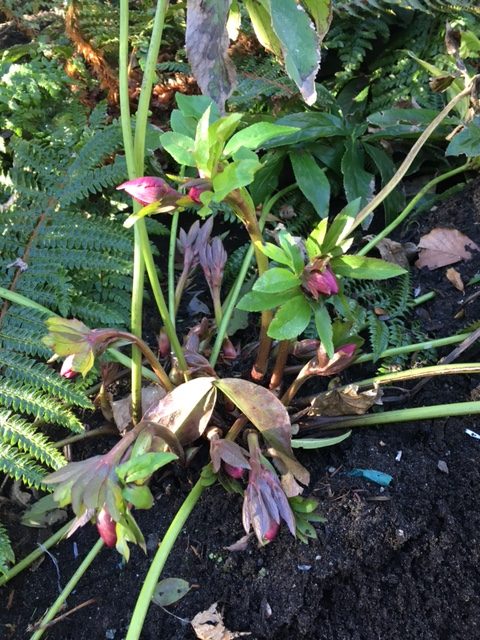
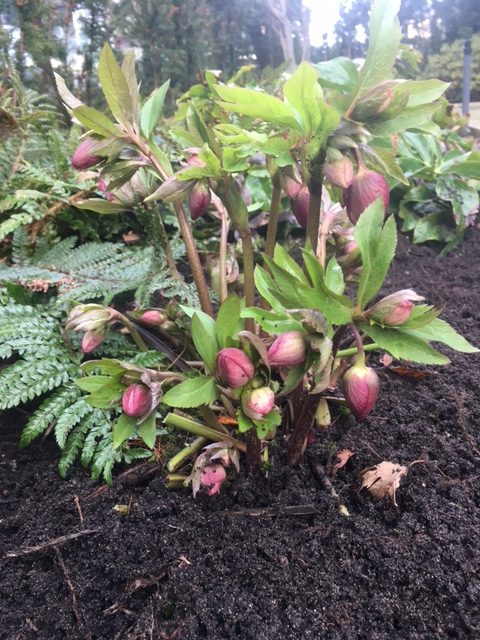
Hellebores
I left my Hellebores alone until new flowers and foliage started showing. Then I clipped off the old leaves hugging the soil. I just hope we don’t get any more crushing cold temperatures.
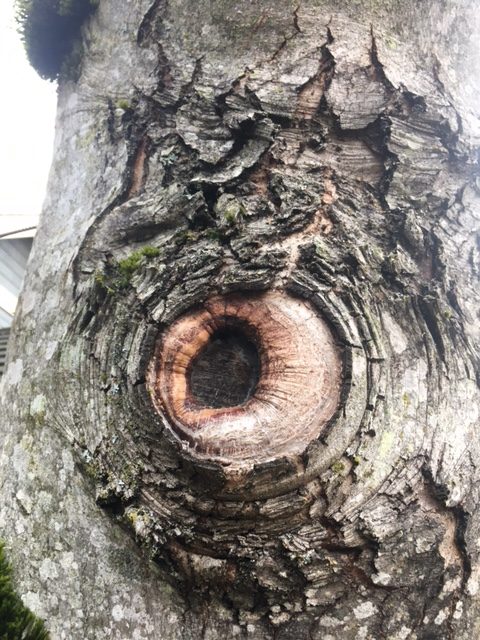
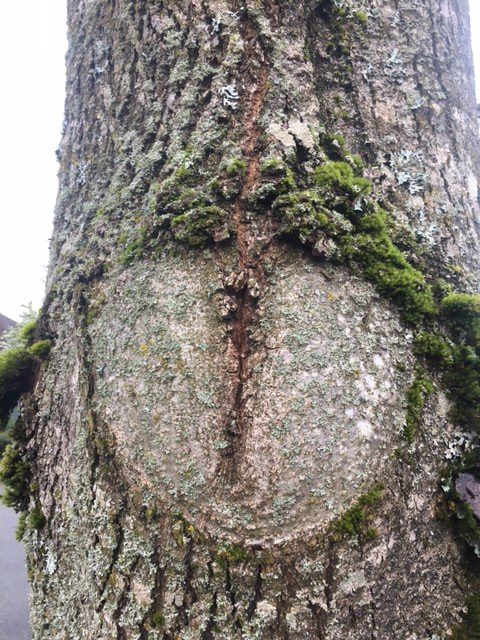
Trees at work
Trees work hard at closing pruning wounds. Otherwise, they risk inviting decay and deadly fungi.
It can take a few years for the tree to cover up a wound.All covered up!
Thin mulch
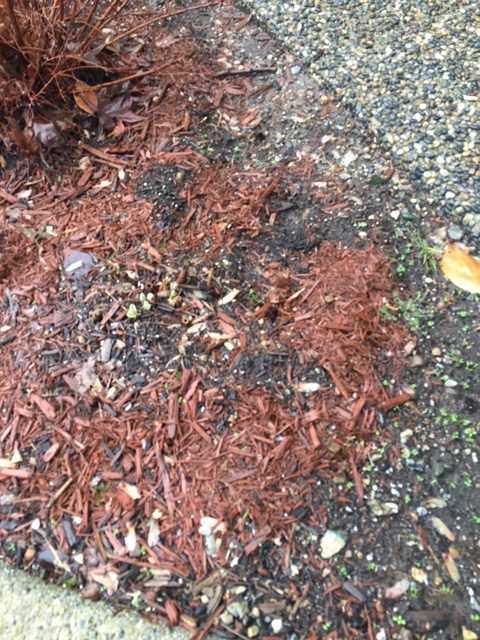
Thin mulch application.
I’m not a fan of thin mulch applications. In the above photo the red and black colors clash. A better approach would be to either give up and keep the original dark soil, or, apply a nice two-inch layer uniformly across the bed.
It’s important to remember why thin mulch applications are bad. They don’t keep weeds down because light can still reach them; and they still trap moisture, which then allows the weeds to thrive. Put down at least two inches or give up.
Give up on cedars?
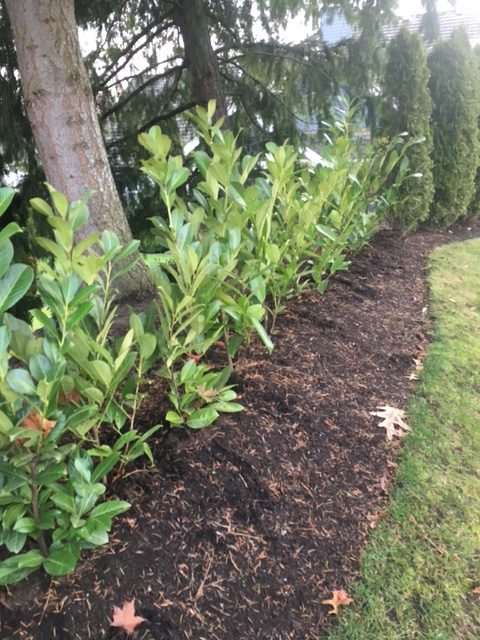
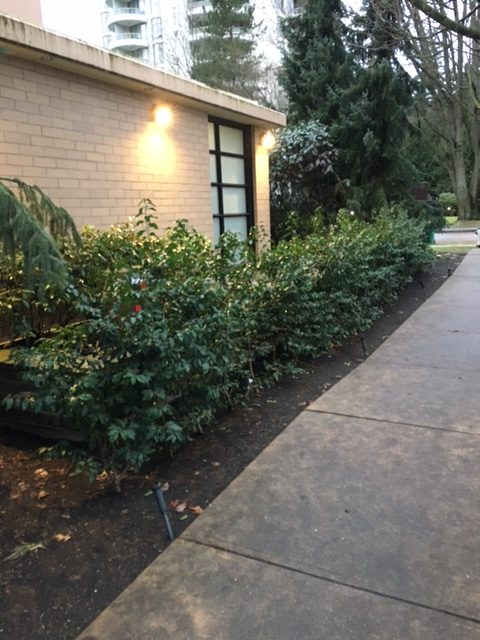
It’s fairly common now with drier summers to forget replacing cedars (Thuja occidentalis) with more cedars. Some people are stubborn and still do it; others give up and plant laurels or yews which seem to do better.
You can see one example above. The cedars didn’t do well under mature Douglas fir (Pseudotsuga menziesii) trees and the site managers weren’t brave enough to plant more cedars. Instead, they opted for English laurels (Prunus laurocerasus). I would do the same considering our recent dry summers.
Conclusion
Get through your winter ox-days and your reward will be warm spring.
Winter time is perfect for training your employees and for practicing in your own gardens. Since there is very little happening in the landscape, you might as well invest some time into training. It helps that trees are dormant and their crown structures are clearly visible.
One prominent landscape maintenance company posted pictures on LinkedIn recently, showing small groups of workers in safety vests, attending training seminars in the field. While I consider this company to be the ultimate sweatshop, I must admit they’re doing it right. It’s smart to invest in your employees with training time. For one, they go home excited and more confident; and two, they will likely make fewer mistakes during the season. Training never really stops, even for the trainers. Personally, I have to learn new things every year to stay happy.
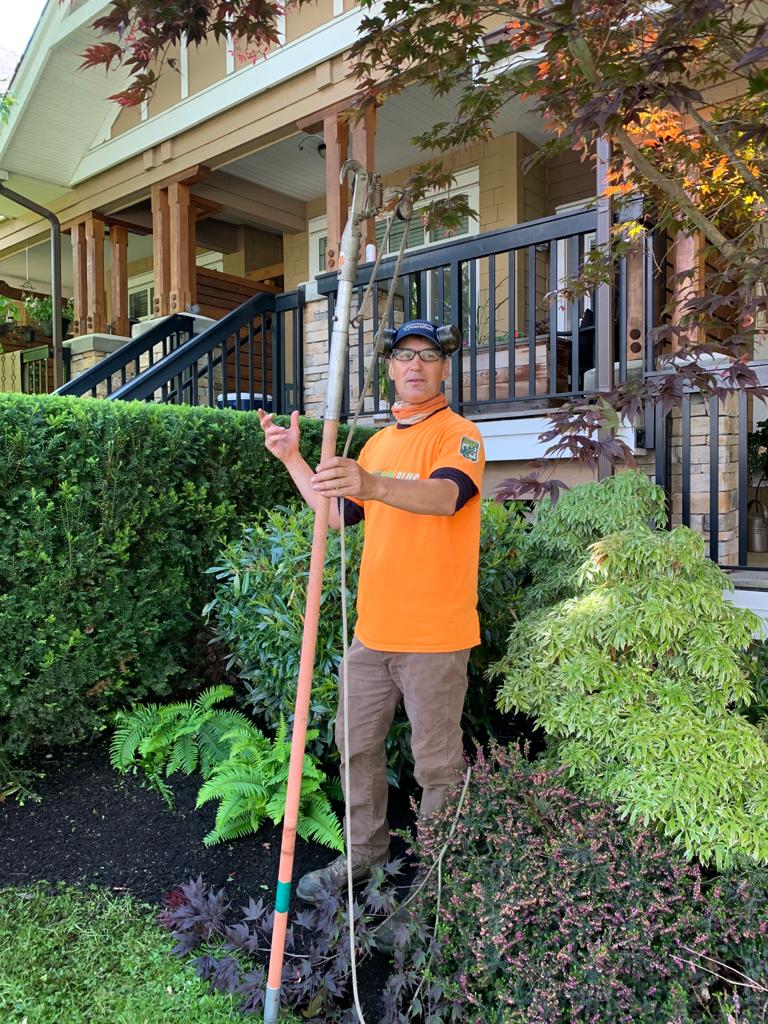
ISA certified arborist Vas
Columnar beech
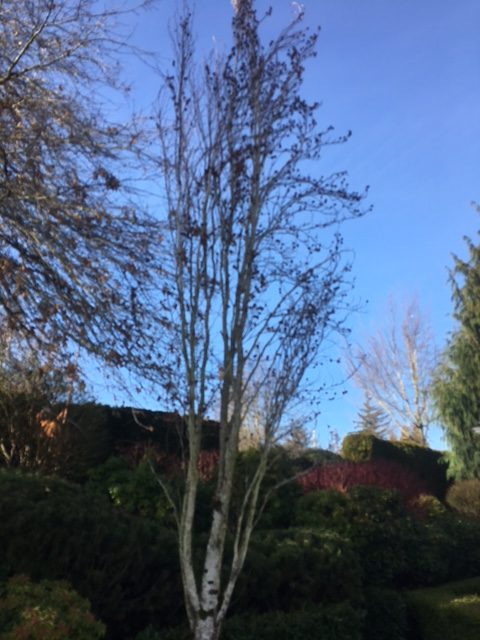
While doing bedwork last week, my apprentice and I noticed a columnar beech (Fagus) that wasn’t looking columnar anymore. So, I guided my apprentice in making several heading cuts that brought the tree back into shape. It also served as a nice break from garden work.
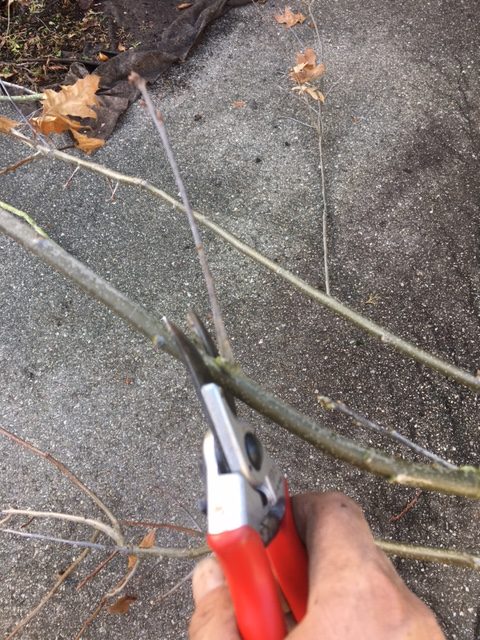
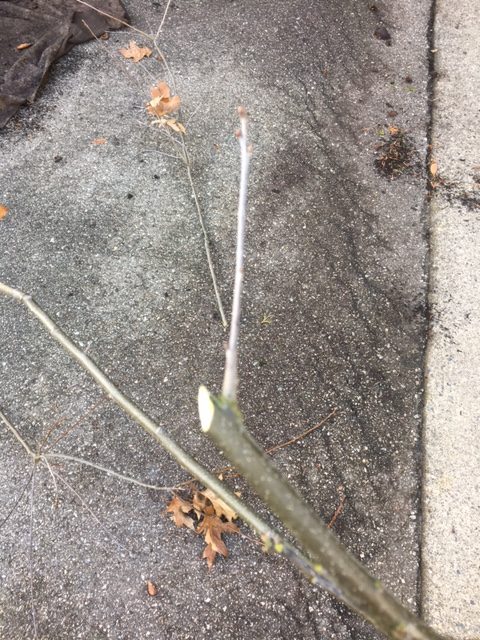
It’s important to make the cuts above a branchlet, not in the middle of a branch, which would leave a stub. See one example below on a Pin oak branch (Quercus palustris). The best cut is made above the branchlet.
Make the cut above a branchlet.After picture.Much better! This beech tree looks like a column again.
After making the columnar beech columnar again, we turned our attention to a large Pin oak (Quercus palustris), which is how I got the pictures shown above. The lower branches were interfering with shrubs and even growing into our beech tree. So, we gave it a nice gentle lift with heading cuts like the ones shown above. One upside of this work is allowing more light to reach the cedar hedge (Thuja occidentalis) below the Pin oak.
Another company I know is sending an arborist over the next six weeks to show each landscape crew how to prune trees. This way, when small things come up, the foremen can take care of it well. We know that branches will break or be broken by delivery trucks. We also know that branches will interfere with unit access and views; and sometimes we have to make corrections after homeowners hack up their trees.
Conclusion
The landscape is quiet in winter and the trees are dormant so use your winter time to train your crews or friends how to prune correctly. I spent maybe an hour with my apprentice last week and his confidence is growing.
I love filling in on strata sites when the regular foreman is missing. Sometimes they’re on vacation, sick, ill with COVID, or laid off by choice. Whatever the case, it’s fun to examine their sites and look for adjustments that can be made when the new season hits. 2023 here we go.
Mow lines
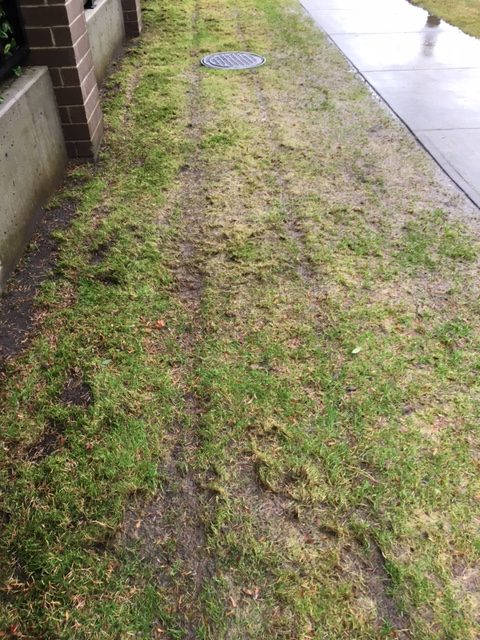
What’s wrong with this picture?
What’s wrong with this picture?
Obviously, the lawn care dudes mow like robots so now we see clear dips in the lawn where the mower wheels run. Every single time! Now that the grass isn’t growing in January, it’s especially noticeable. And I’m not a fan. I prefer seeing a uniform green lawn without any dips that could potentially injure my ankles or swallow small pets.
I would correct this problem by instructing the crew to alternate the starting lines of their mowers. For example, start mowing a bit farther away from the sidewalk edge and the wall. Yes, you will have to line trim a little bit more grass but it’s worth it.
Don’t mow like robots.
Curbs
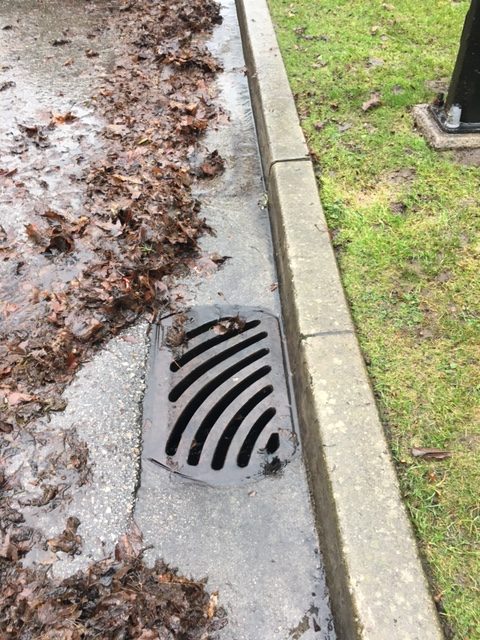
Whatever you do inside the complex, this curb will always detract from your work presentation. I know that some of you will disagree, telling me that the city is responsible for curb maintenance. And technically speaking you’re right. However, nobody knows when the city sweeper is coming. Can he handle curbs caked this badly in soggy, decomposing leaves? And are you sure that all of the parked cars will obey your signs and move away from the curb?
Landscapers are definitely responsible for keeping drains open. Since I know this, I blew away the curb edge to let the water flow away.
I would correct this problem by blowing the curb edges as soon as leaves start to fall. Early on the leaves are still dry and fluffy. Blow them onto lawns before you mow or, make small piles and rake them up.
If it’s windy, then you can discreetly blow the leaves into the neighboring municipal park or directly across the street to your competition. Of course, this could start a war so be careful. Conversely, if your curbs are caked in leaves and your competition is super clean across the street, you know you’re getting abused.
Conclusion
Your strata complexes will look better in winter if you take good care of your curbs and mow correctly all year. Avoid heavy leaf accumulations in curb edges; and don’t mow your lawns like a robot. Alternate your starting mow lines to avoid creating huge dips in the lawns with your mower wheels.
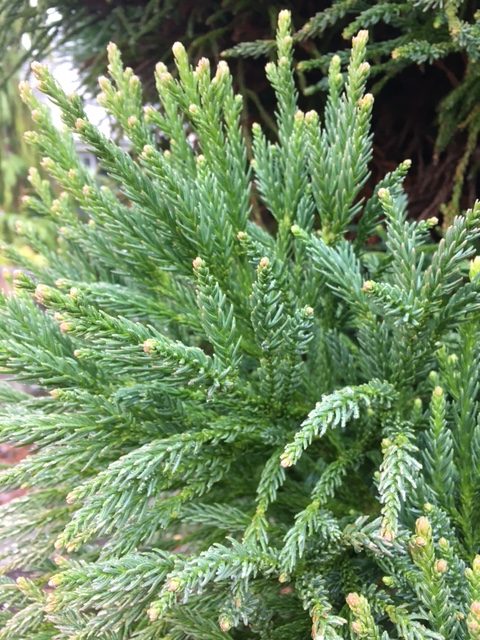
I openly admit to struggling with conifer plant identification. For example, just last week I was on a large strata site in White Rock. My co-worker kept on calling the conifer in his hand Japanese cedar and I looked at him suspiciously. I knew that the botanical name for Japanese cedar -always try to use botanical names- was Cryptomeria japonica; and there were several mature specimens on this site. The conifer he had to remove didn’t look like Japanese cedar but at that moment, its name escaped me. Alas, that’s usually what happens to people who desperately try to learn botanical names. You learn five, and forget three. Sometimes I have to blog about a plant just to remember its name. So, don’t be alarmed, keep at it.
Cryptomeria japonica (Japanese cedar)
A new weapon
I stopped thinking about my work day until I visited my local Chapter’s book store after work. There, in the nature section, I found a copy of a new weapon that will help me and you become an expert on Pacific Northwest conifers.
The book is well-designed, and full of color photos and charts. It’s called “Native and ornamental conifers of the Pacific Northwest” by Elizabeth A. Price (Oregon State University Press, 2022). Did you notice the twist? This guide covers native conifers found in the wild AND ornamental conifers found in people’s gardens. I couldn’t find the book price anywhere but I bought it anyway. As an arborist and professional landscaper, I knew I could use this guide.
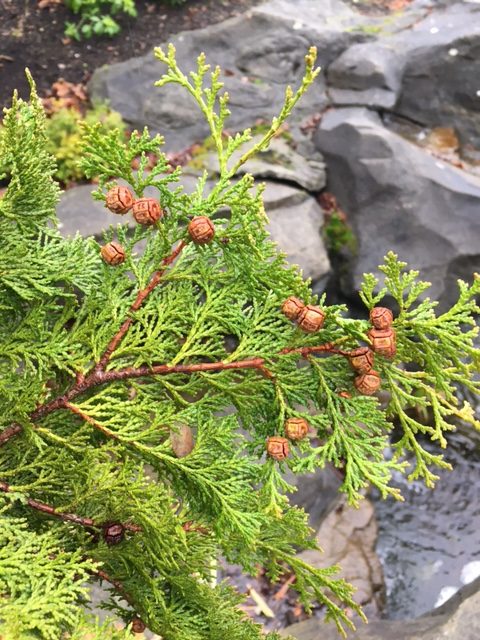
And that’s exactly what I did. I knew that the conifer we removed wasn’t a Japanese cedar. I recognized its foliage and cones but the name escaped me until I opened up my new, shiny guide. We removed Hinoki cypress or Chamaecyparis obtusa. No wonder I had trouble remembering the botanical name. Even today I struggle to pronounce it properly.
The brown cones on Hinoki cypress have moderate horns and straight scale edges. Sadly, nobody bothered to salvage the Hinoki cypress. We ruthlessly flush cut it and dumped it on the back of the truck.
I look forward to consulting my new conifer guide at work and at home. When you visit your favorite book store, check it out.
I had no idea Honda had announced it was stopping their gas mower production after this year, until I talked to James, the owner of this website and Proper Landscaping Inc. This happened in September 2022.
Why would Honda stop making mowers?
“Honda mowers will go down in history as the most durable commercial mowers”, says Desmond Early. Des owns and runs Foreshore Equipment, the best dealer in British Columbia. He would know.
Years ago, when he upgraded his mower fleet, he sold me one of his Honda commercial mowers for just over $100. I still have it, and it still runs. Since I don’t mow a lot when I side-hustle, I barely touch it. I did buy new blades and air filters.
It’s hard for me to admit, but oil changes seemed like a lot of work, so I skipped them and the machine still ran fine. I would haul it out in spring, pull the cord a few times, and it would come to life. That’s a true Honda story.
3 reasons
Honda gave three reasons for stopping their gas mower production but not much detail. Honda cited regulations, customer preferences and focus on profitable products.
States like California are coming out with tougher regulations, and people prefer to buy electric or battery-powered units for their homes. For homeowners with small yards, buying a Honda mower is overkill.
Also, the battery powered technology is much improved. See my blog post on the latest from Kress, which uses German technology. Kress promises quick battery recharge times and power output comparable to gas machines. Now, if a homeowner can avoid sucking unhealthy fumes on Saturday afternoon with battery powered machines, why wouldn’t they switch.
Obviously, I can’t comment on Honda profits but clearly they will concentrate on producing something else, like ATVs. Maybe they don’t really care about mowers and landscaping.
I think Honda sees the coming shift away from gas powered mowers and it’s repositioning. Whatever the case, the future is exciting with new technology coming online. I can’t wait to test some of it in the field. I’m tired of sucking exhaust but I’m keeping my old Honda mower for now.
I was planning to write a quick blog post about color finally showing in our landscape in late January and this morning it snowed!? Now the landscape is all white but trust me, there is color out there. Let’s see what will emerge once the snow melts.
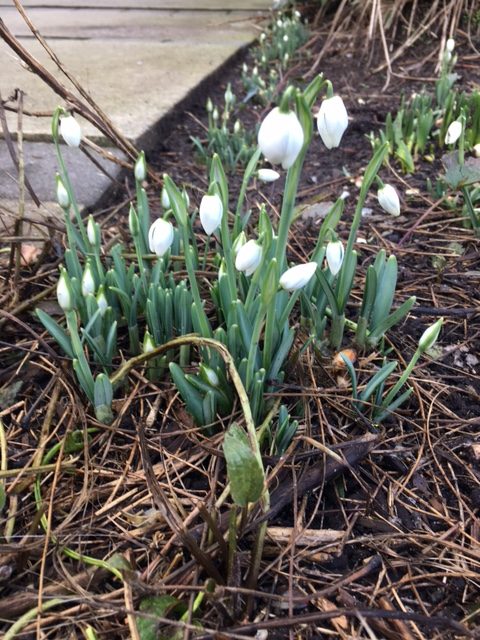
Galanthus
Snowdrops look awesome, especially when mass-planted. Every time I open my UK gardening magazines and see masses of snowdrops under trees, I freeze and stare. What a show! I wish I had a huge garden to do the same thing.
Galanthus by Coquitlam City Hall
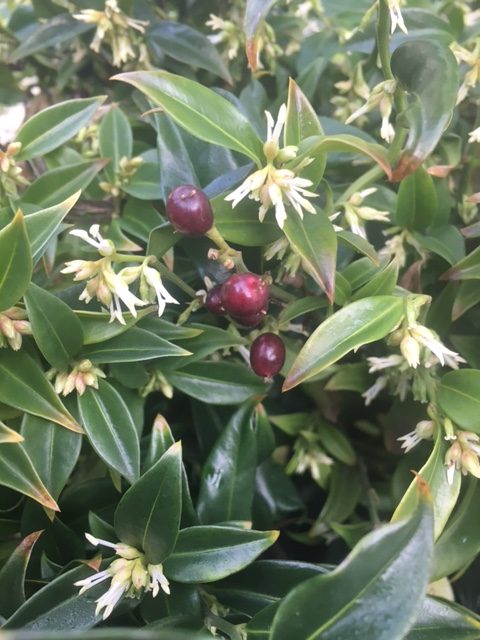
Sarcococca
Sweetbox adds white flowers and fragrance to our winter landscapes. When it’s planted along walkways, the fragrance will hit your senses before you even notice the small white flowers. With the winter landscape quiet, it’s nice to have sweetbox. Like Galanthus, it’s best to mass-plant Sarcococcas.
When I see obvious spikes pop-up, I snip them off by hand. Larger sections can be lightly power sheared.
Sarcococca
Hellebores
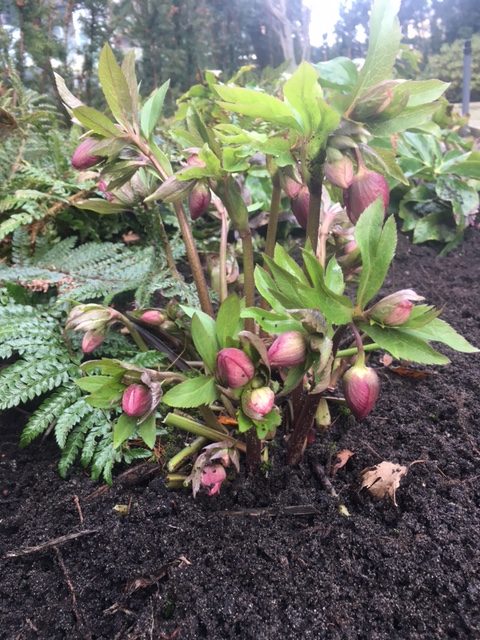
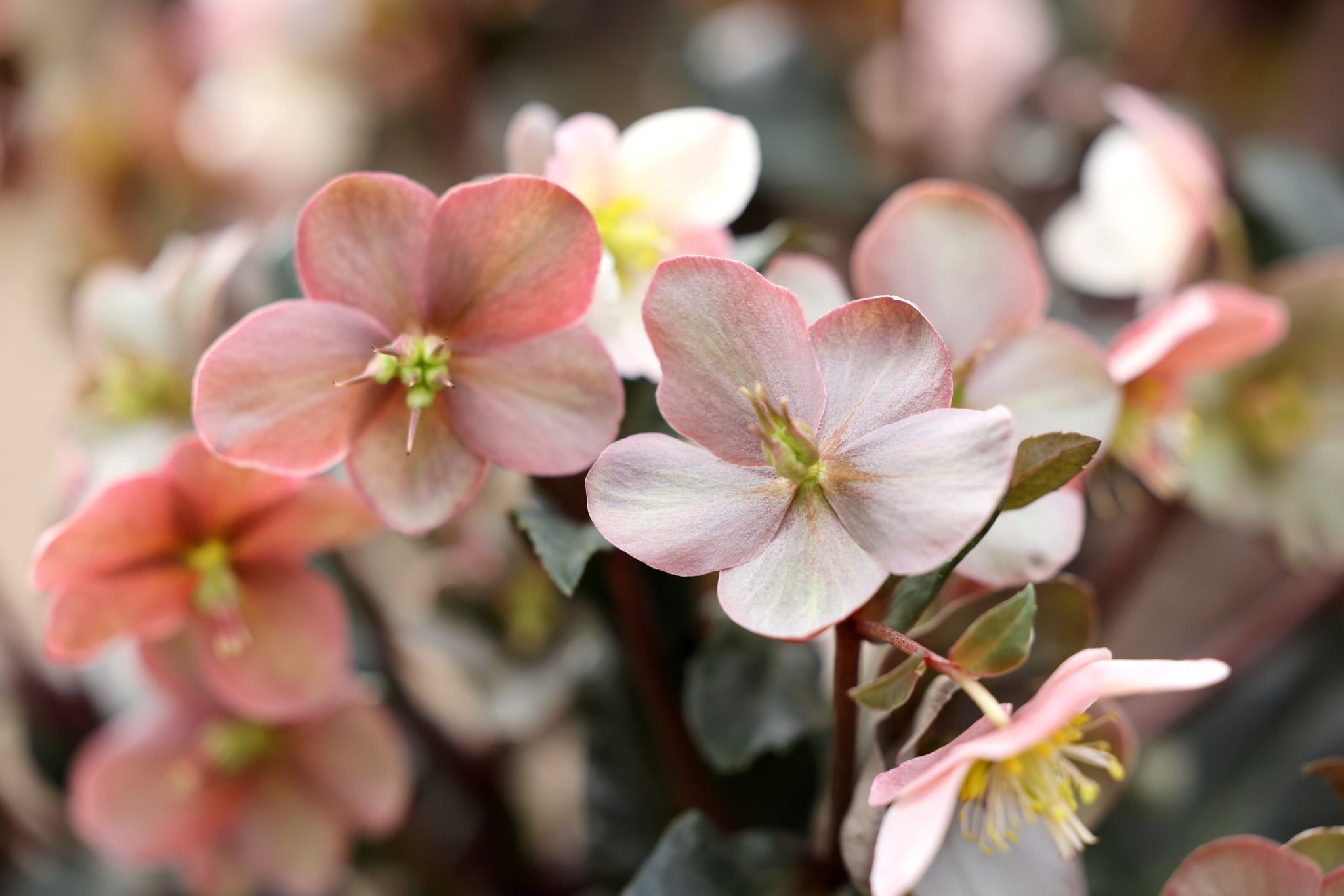
Hellebores are also flowering now and bringing some welcome color to our landscapes. Once the new flowers and foliage start popping up, I snip off the old leaves hugging the soil. Some of them can look a bit beat up anyway so snip them off and enjoy the new growth. This is the only action you have to take.
New flowers and leaves
Shrubby honeysuckle
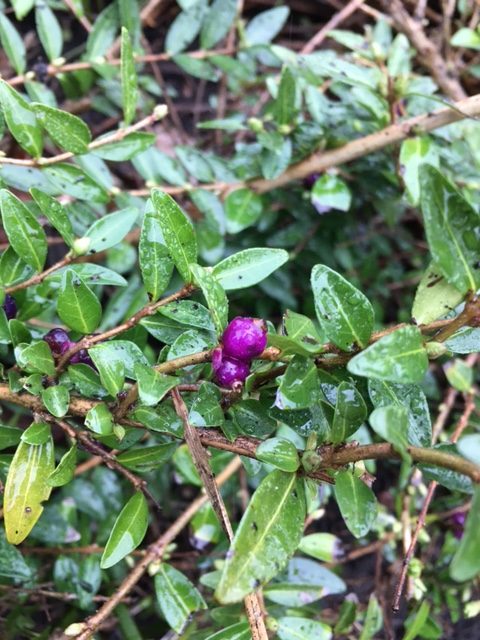
I love these purple berries on shrubby honeysuckles (Lonicera nitida). They pop right out when I cultivate the soil around them. Shrubby honeysuckle is a perfect plant for low level hedging. This specimen is planted just behind a parking curb where it creates a nice border but never grows too high as to interfere with site lines.
This honeysuckle will get power sheared periodically to keep it inside the bed.
Witch hazel
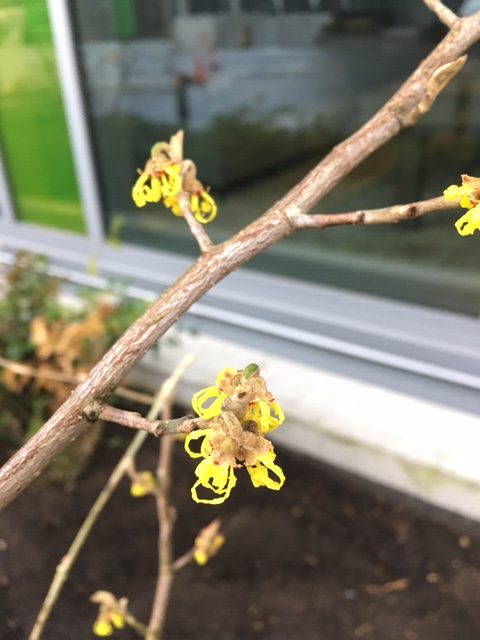
Hamamelis mollis
By next week these spider-looking flowers will be fully extended and they will brighten up the entrance area of this residential high-rise tower in Burnaby’s MetroTown area. They will also improve my mood as I work around them.
If the shrub is getting out of hand, feel free to clip it lightly after its done flowering.
Today, January 31, 2023, we have snow on the ground but spring is coming. Once today’s snowfall melts away, look for the plants above in our landscapes. They might lift your spirits.
Landscaping work in the private sector is driven by profit, and it’s very difficult to generate profits if your workers stop to notice details in the landscape. It’s go, go, go all the time.
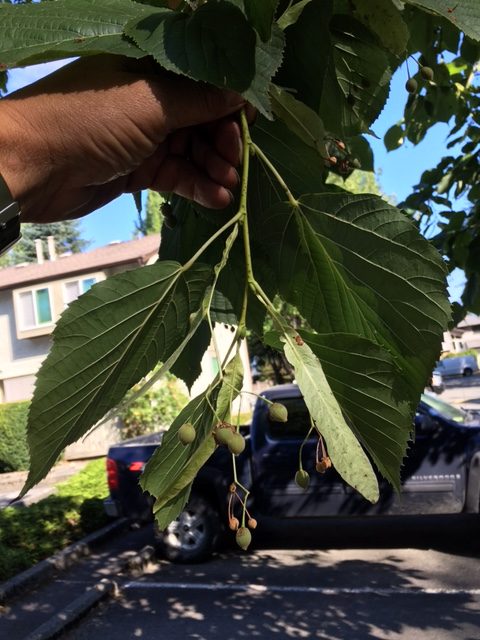
This past summer I was helping at an older site, predictably populated by mature trees. And right at the entrance to an inside planted courtyard stand three mature small-leaved linden trees (Tilia cordata).
Now, as I made passes through the entrance, I noticed something different in the air, but I pressed on with my regular lawn care duties. Lawn care is always done first.
Asian mommy
Just as I passed under the lindens, a lovely Asian mommy walked up with a baby stroller, and she had a huge grin on her face. I also noticed, in passing, that she could have been a model for Lululemon tights. That’s all can say in a family blog.
So, why the grin? The fragrance, of course! The lindens easily overpowered the smell of my gas-powered machines. Then the lady stopped her baby-stroller and asked me if I had noticed the smell. Of course, I had. Vaccinated against COVID, my sense of smell was totally fine. I just couldn’t describe the smell.
Tilia flowers
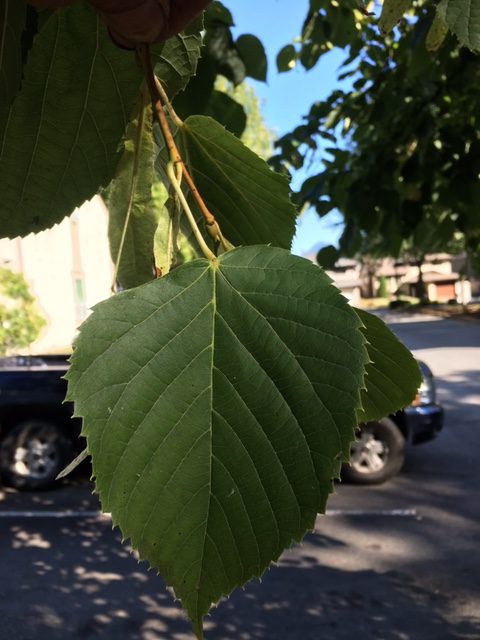
The small Tilia cordata yellow-green flowers come out in early summer. You can easily identify the tree species because under the flowers is a bract. The flower scent is rich and heavy, says Wikipedia. And it really is. It can put a smile on your face.
The fruit is a dry, nut-like drupe.
Lindens are native to Europe, and they’re deciduous trees growing to 20-40m. The specific epithet “cordata” means heart-shaped and refers to the leaves.
Lindens are disease-resistant trees and they’re used as ornamental trees. Thus, their placement inside a high-profile corridor. I wonder how many more residents had noticed the fragrance.
Watch out for linden trees in your neighborhood early this summer. See if you notice their amazing fragrance. If you’re lucky, your neighbors will alert you.
The new year is here and the garden is very quiet. But if you look closely, there is some fine-tuning you can do now. Assuming you feel motivated to go out into your garden in January. Let’s take a look at some of my work.
Black eyed Susans
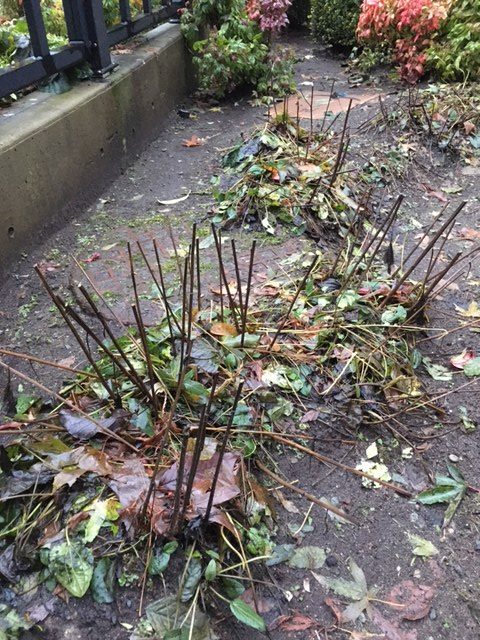
I’m not a fan of stubs. On trees they die and create a pathway for diseases to enter. On perennials like Rudbeckias, they create homes for bugs to move into and sharp sticks for gardeners to get stabbed with.
I hate this look. If you must cutback your Rudbeckias early, use hand snips and enjoy the work. Remove the entire flower stalk so only the basal leaves remain. It will look much better. These long stubs look weird.
Clean up tree damage
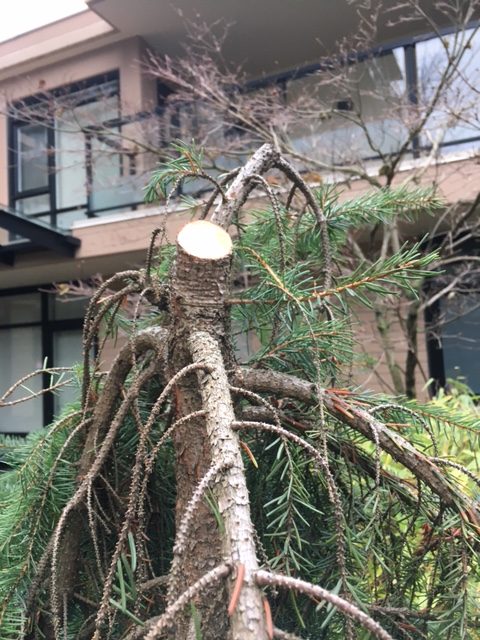
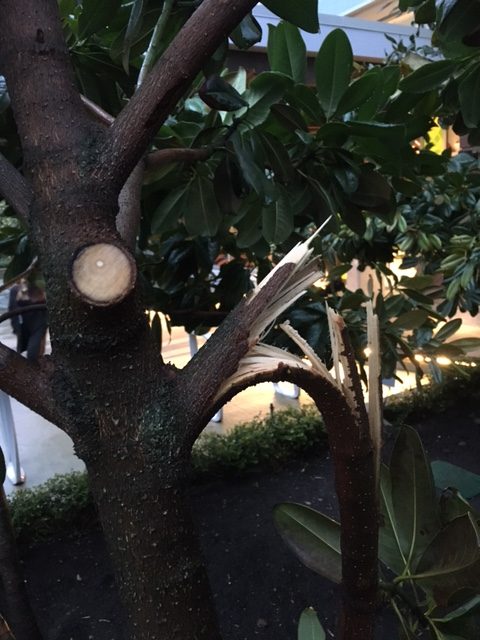
If you don’t manage to knock off snow from your trees before damage occurs, then just make sure the break points are cleaned up. I found one small evergreen with a broken top so I cut it to make it look decent. Always use sharp hand saws.
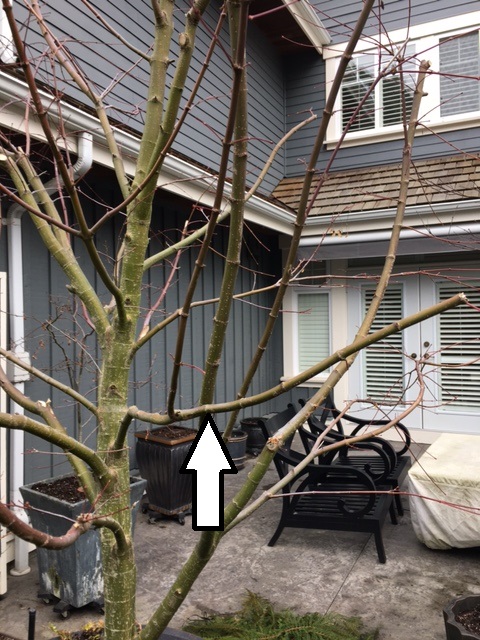
Rubbing branches on trees should also be eliminated. See the white arrow.
Perennial cutback
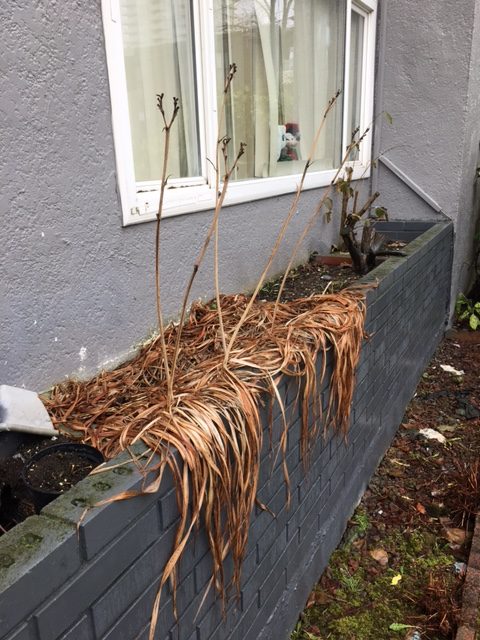
January is a good time for perennial cutback but it’s not critical. Just get it done before spring hits. Personally, when I see the bed below, I don’t want to wait any longer.
This deserves a clean up.
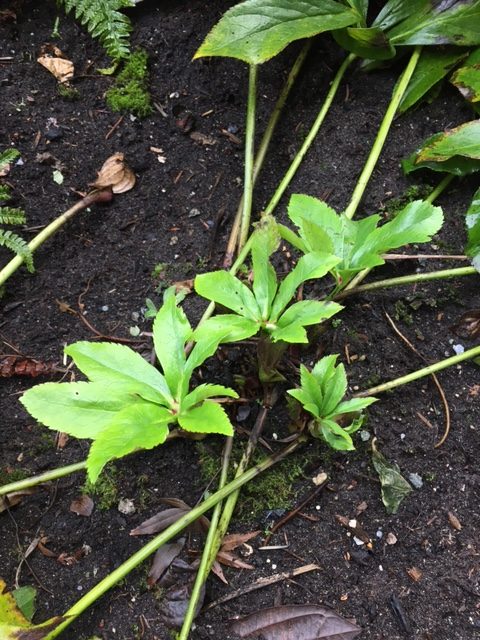
Once Hellebores start pushing out new foliage, you can clip back the old leaves. Flowers follow. I don’t like to rush this. The old leaves at least give us something green to look at.
Now you can cutback the old leaves at the base.
Conclusion
Take a good look at your winter garden to see if you can fine-tune it a little bit before spring. There is always something to do.
I really enjoyed the two native plant seminars I attended last summer at the University of British Columbia (UBC) botanical garden. Sadly, I missed the first one because I had side-hustle clients to keep happy.
Everything came together nicely for me. First, I stumbled upon the seminar ads online purely by chance and at $40 per session it was a steal. I signed up online right away. Keep reading if you want to know why. Second, my wife and kids were away visiting the in-laws in Western Japan. This meant that I could drive over to UBC after work without having to make special soccer and sleepover arrangements; or think about chores.
The setting
As a landscape pro I love most gardens, especially botanical gardens. If you’ve never been to UBC’s botanical garden, correct your oversight in 2023. When our native plant walk started, the gardens were officially closed to the public. Yeah! It was all for us to enjoy.
With the garden closing to the public, I didn’t pay the parking fee. I’m not great at math but I knew that closed gates would make it hard for by-law to show up. Twice I didn’t pay and it worked out fine; but I did get long looks from the other well-heeled attendees. Your choice.
It was sunny and warm on both days and the plants looked awesome.
The teacher
Allison Luke, the instructor, is extremely likeable. When she first walked over to meet me, smiling, I had assumed she was one of the attendees. I was wrong.
Whoever hired Allison to run the horticulture program at UBC is an HR professional. She knows her plants and obviously enjoys talking about them. Incidentally, she replaced my mentor Egan Davis, who moved on to work for the City of Surrey. Egan was also the guy who taught my one day Red Seal challenge preparation course. Without him I wouldn’t be the high-priced Red Seal journeyman I am today and I will be forever grateful to him.
I was impressed with the seminar logistics, too. Like washrooms being open, insect repellant patches and sunscreen ready for the attendees to use. We were also promised a full plant list at the end of the seminar series and it did arrive in my inbox. I don’t recall receiving any junk mail so don’t be afraid to leave your email address in future seminars.
A nice touch
Some time into my first walk (seminar number 2) we sat down under a massive Western Red Cedar (Thuja plicata) and proceeded to read passages from the excellent bestseller “Braiding sweetgrass” by Robin Wall Kimmerer. I thought this was a nice, unexpected touch. Then, out of nowhere, one of the male attendees ruined the vibe by informing the group that any contact with Western Red Cedars can leave his skin looking worse than a leper’s. Why he picked this moment to disclose his medical history I will never understand.
The plants
The plants at the UBC botanical garden are beautiful. I won’t reveal too much here but I will give you a hint in a future blog. Come see for yourself. And if UBC offers these summer seminars again in 2023, jump right in. I really enjoyed the sessions and I’m sure you will, too. Bring a notebook and make sure your iPhone is charged.
Speaking of plants, eat before you come over to UBC. I never sample wild plants because I’ve read “Into the wild“, the story of Christopher McCandless. Christopher gave away his money and possessions and walked alone into Alaska’s wilderness. Eventually he camped out in an old school bus and he died in it after eating the wrong wild plants. Thus my own reluctance to sample wild plants.
Of course, at UBC I watched Allison and the other attendees sample the wild plants first, before joining them. Facing your fears can be fun.
My favorite tree at UBC
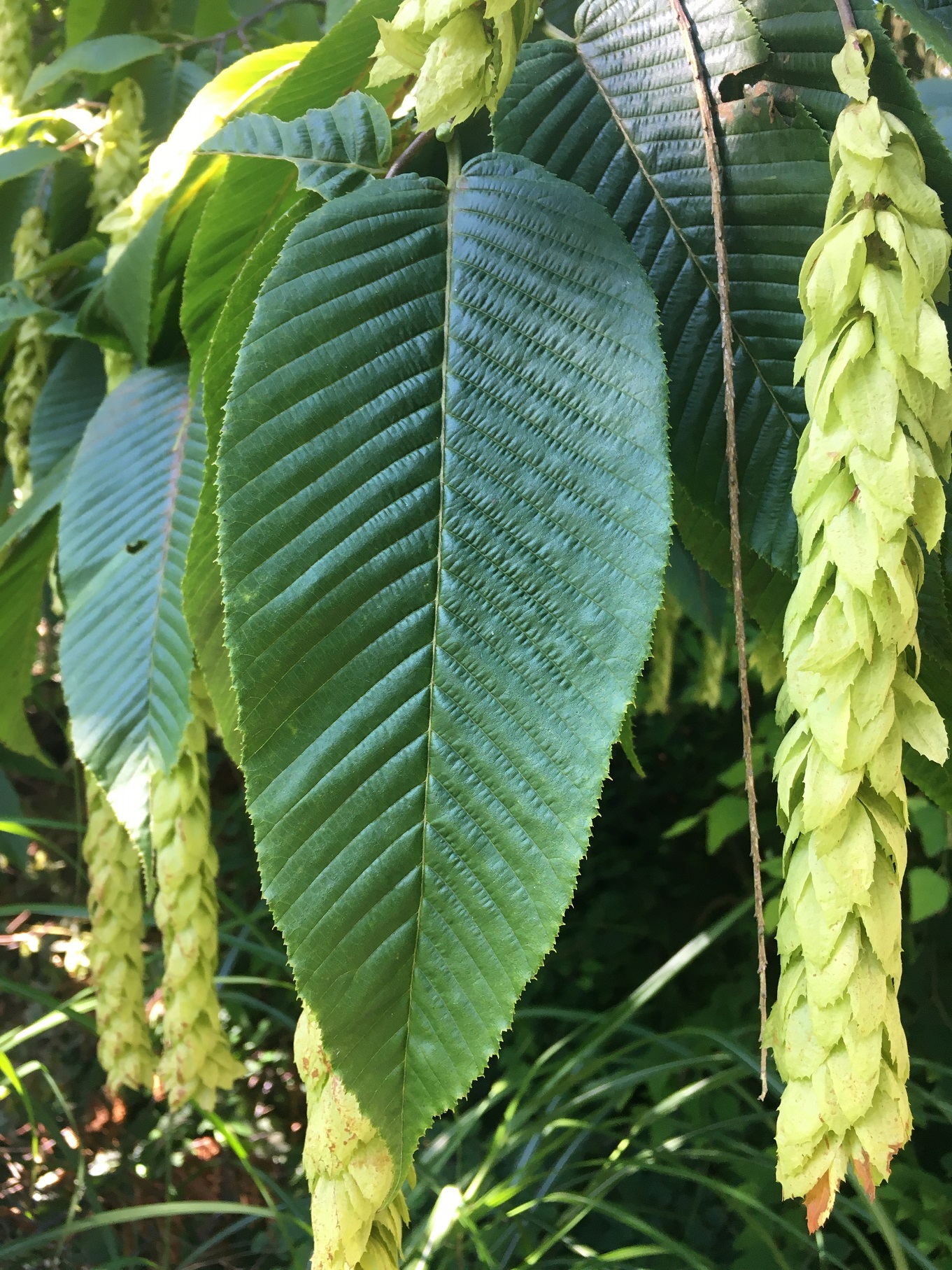
Barely a minute into your botanical garden walk, there is a spectacular tree tucked away on the left, slightly off the main walk. It’s called the monkey tail hornbeam (Carpinus fangiana). Our streets are populated by the smaller Carpinus betulus, which nicely hint at its birch family, Betulaceae. The leaves look like birch leaves.
The long catkins or flower clusters give the Fang hornbeam its monkey tail name. If you look carefully, both tree species have seeds partially covered by bracts which form what botanists call involucres.
Carpinus fangiana
Conclusion
I really enjoyed UBC’s summer native plant seminars in 2022. If you get a chance to attend one in 2023, do it. I will. Even if it’s a bit of a drive after work and I arrive hungry, desperate to try any wild plants on offer.
It’s good value at $40 per session, the instructor is extremely knowledgeable and so are many of the attendees. Just bring your notebook and be ready to learn. But, please, keep your health problems to yourself.
I love going back to sites and seeing how my plant installs are doing. We know it’s not always good news, like the case of my yew screen. I always feel responsible for the plants, as if they were my dependents.
The line of Portuguese laurels (Prunus lusitanica) shown below is doing well. We didn’t lose a single specimen, which is fantastic. We’re finding that Portuguese laurels do much better in heat than cedars (Thuja occidentalis). Also, note that the heights are mostly uniform because the light levels are fairly even.
Prunus lusitanica Portuguese laurels
English laurels
Now let’s walk away from the Portuguese laurels, around the corner to the back, and see a line of English laurels (Prunus laurocerasus).
Prunus laurocerasus English laurel
What do you notice here? The plants are doing fine; they’re clearly receiving water from nearby sprinklers. However, you will notice how slanted they are. The left side is doing extremely well, while the right side looks like the youngest sibling. I planted them all at the same time. The big difference is the nearby Japanese snowbell tree (Styrax japonicus). It clearly shades out the laurels on the right and competes with them for resources.
That’s basic plant biology. Plants need access to light so they can produce food in their leaves through photosynthesis. Less light means less food. The effect of shading is nicely visible here. Not as obvious is plant competition where the roots compete for resources.
Changes
You can leave it as is, or, you can prune the laurel hedge to even it out. Another option is pruning the trees around the hedge, mainly the Japanese snowbell nearby. If the unit owners are worried about privacy, you can just thin out the trees by removing selected branches. Raising the crown by eliminating the lowest branches is more obvious. Both pruning procedures would allow more light in.
Always check with the owners before making significant changes.