
All Posts By

Vas Sladek

A four-day work week for everyone?

By | health and safety, Landscape Industry, Management | No Comments

Is it time?

A four-day work week would be great for individuals, and for the entire economy, writes Amir Barnea in today’s Globe & Mail (February 9,2026, page B4). Canadians usually work forty hours a week, but a survey of five thousand employed people found that 39% felt burned out. Is it time for the whole country to adopt a four-day week? I think so.

The article mentions a software company which made the switch to a four-day week. The company owner thinks it’s difficult to get consistent good work out of her staff working the normal forty hours a week. She’s getting better results now, while her staff works 20% less. How does she know that her staff perform and feel better? She notices it in her own life.

Scientific proof

Juliet Schor has done the research, and here’s the proof that shorter work weeks are good: 90% of the companies that tried out the four-day week idea, kept it after the study ended!

The switch can be made, if companies sacrifice a little bit of their profits. And municipalities, which operate on budgets, not profits, are great places to start.

If you want to read more about it, see Juliet Schor’s book “Four days a week”. I put it in my Audible wish list.

4-day week in landscaping

Personally, I love four-day work weeks. It would be hard to go back to five days. My day-job company switched to four day work weeks two years ago by extending the four work days to nine hours. So we work 36 hour weeks, and get paid for forty. Now, that sounds generous, but there is travel time to consider. The company used to pay for travel time but now that’s over. It’s part of the remaining four hours we get paid for.

Now, having three days off is pure magic, especially when your job is outdoors all year and physically demanding. I believe my day-job boss gets good work out of his employees, but nine hours can be physically taxing. By Friday, some people desperately need the third day off.

The free Mondays can also be used for appointments and long weekend trips, which definitely improves people’s well-being. The Sunday night work anxiety is gone.

No burn out?

As for burn out, I can’t say that the shorter week solved my burn out problem because I work for myself on weekends and Mondays. I’m not bored, I have hobbies, and my body needs rest, but living in the Lower Mainland (British Columbia) is expensive.

To make it financially, I have to risk burn out by working more. But my life satisfaction is still higher. Being able to work for myself on Mondays means extra income. Crucially, most of the work is done on project basis, not by the hour. So I can squeeze more revenue out of every Monday. That makes me happy, and keeps my family far away from food banks.

Make the switch!

I think the whole country should switch to four-day weeks. It does improve work performance and life satisfaction.

There would be one other benefit: you could easily switch jobs. Right now, there is plenty of work for an experienced, certified landscape professional, but very few landscape companies work shorter weeks. That makes it hard to switch employers because I need the free Mondays to work for myself.

How to identify weird tree branches

By | Pruning, Trees | No Comments

Winter pruning

Winter is the best time for tree pruning because trees are dormant in winter, and the crown structures are visible with the foliage gone. That also makes it easy to make the cuts. Making nice pruning cuts is a nightmare in summer because it’s so hard to see.

Lately I’ve been seeing lots of crazy tree branches and I want to go over some of them. That way you’ll know what to look for on your trees at home.

Hard right

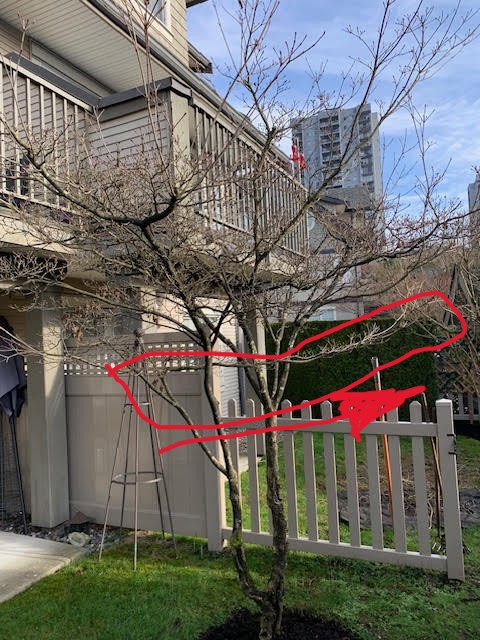
This dogwood tree has a weird branch making a hard right turn right through the crown. That’s not ideal for this arborist. No, it’s not a tragedy, but the tree looked fine after I removed the branch. We need upright branches.

This is the after photo and nobody even notices that the branch is gone. The tree will flower nicely in summer, and the weirdness is gone.

Abused Skimmia

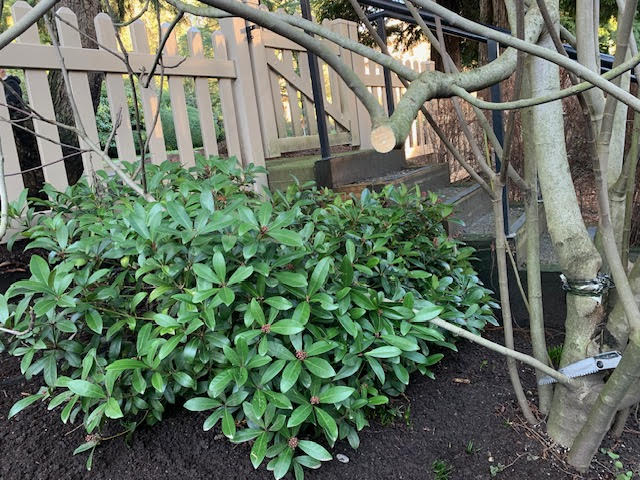
I was in this yard to do finesse work, but when I saw the fig tree taking liberties, I grabbed my hand saw. It took just one cut to solve this problem, but be careful. It’s safer if you make more than one cut, so the weight is off when you make the final cut. You don’t want your bark peeling. I actually held on to the branch as I finished the cut. It worked! And the Skimmia can breathe.

Low fig branch resting right inside the Skimmia shrub. Not on my watch!

Good neighbours

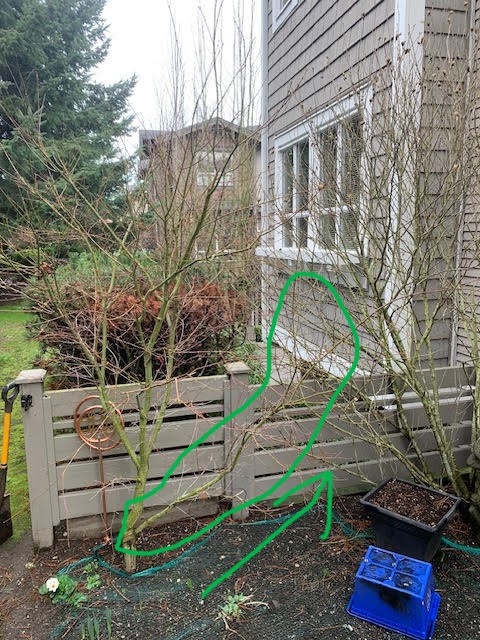
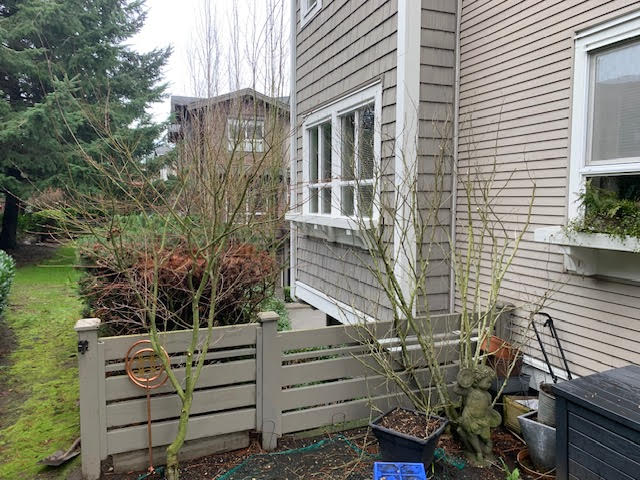
This was another case of one cut solving our problem. The Vine maple on the left had a low branch colliding with a neighbouring Rose of Sharon. If you ignore it, it will just get worse, so why not cut it out? I made one, good cut and that was it. I also lowered the Rose of Sharon a little bit, and I like the separation we achieved with one cut.

Before

After

14 months

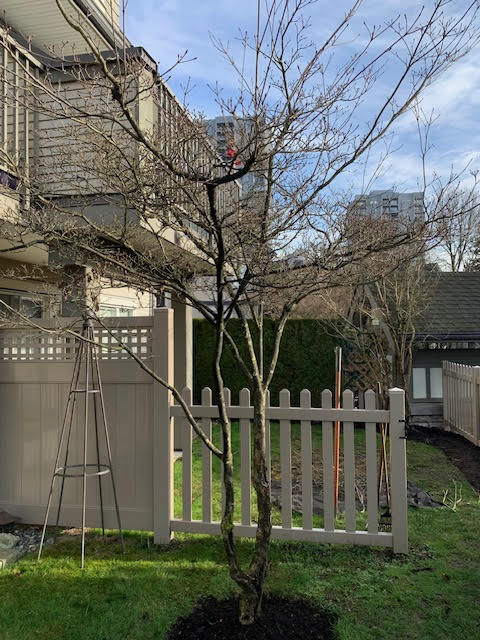
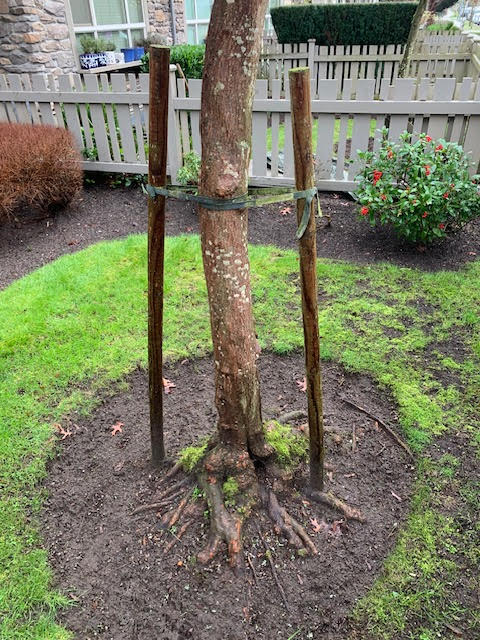
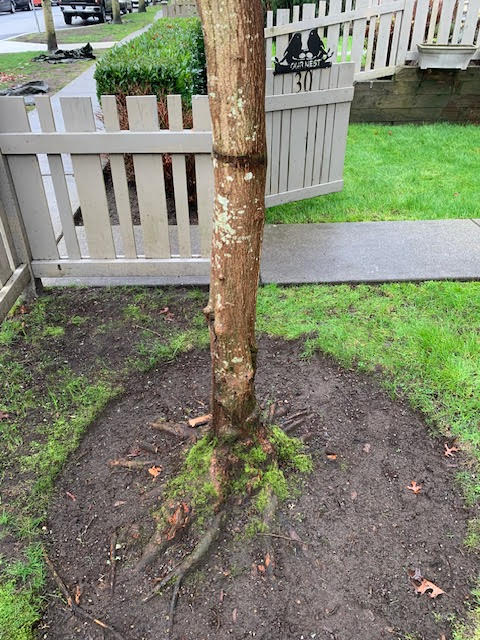
The landscape standards recommend removing tree stakes after fourteen months. The stake on this Snowbell tree have been there for years probably. Landscapers get busy with lawn care and finesse work, so it’s easy to forget about tree stakes. But not in winter, so we removed them, and the tree looks fine.

Conclusion

Winter is great for checking your trees and making corrections. Trees are dormant in winter, and there is no foliage to obstruct your view. It’s surprising how much you can accomplish with one good pruning cut.

What a well-pruned dogwood shrub looks like

By | Pruning, shrubs | No Comments

Dry riverbed

Indian plums are smaller, but the wood is surprisingly tough to cut through.

Dogwood shrub

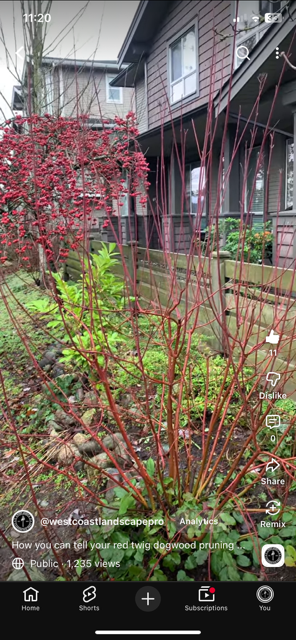
After hacking my way through overgrown shrubs and removing weeds, this dogwood shrub was a revelation because it didn’t require any pruning. Evidently, we did a great job last year, by removing the biggest, dark canes. You can still see the nice gaps we created in the dogwood.

The remaining canes are young and red, which is how it’s supposed to be. It’s a Red twig dogwood (Cornus sericea). Red twig, but only if you maintain it nicely. All I did was snip some of the tops lightly, and then I moved on to other pressing business. Like removing a dead tree, and raking up piles of Big leaf maple drop still sitting on top of ivy.

The loneliest task by far was removing weeds from the rocky bottom of the riverbed. I used my hand tool to remove the weeds, and smiled at the thought of our dogwood shrub. When you do a good job, your task should be easier twelve months later.

If you want to learn more about pruning, check out my YouTube channel, like the videos and subscribe. Then encourage your Proper Landscaping crew to do the same, when you see them.

Hydrangea request for a fussy lady

By | gardening, Pruning | No Comments

First gig of 2026!

Other tasks

Best news for last!

One rushed Pyracantha

By | Pruning, shrubs | No Comments
https://www.youtube.com/@westcoastlandscapepro

Prickly shrub

Pyracantha is a nice shrub we frequently see planted in our landscapes. Its red or orange berry clusters are very showy, especially now as I write this in January, 2026. The berries are hard to miss.

The other key feature of this common shrub are its nasty prickles. After all, its common name is fire thorn; and I have lots of bad experiences with it. Once, I got poked in the hand, at the bottom of my thumb and the area swelled up for days.

That’s why Pyracanthas are planted both for their showy berry clusters and for security, to keep criminals and pedos away from your home. I still remember one project where we planted Pyracanthas along the outer walls of an underground parkade to discourage criminals from breaking in.

Pruning

Pyracanthas like to send out shoots so we keep power shearing them to keep them in check. And they can take it. You can, of course, hand prune them, but it’s slower and it requires a decent pair of gloves.

Now, this blog post was inspired by my recent visit to Langley Memorial Hospital in British Columbia, Canada. I had to wait for one hour and sitting inside a hospital didn’t excite me. I tried, but the constant stream of nurses and patients moving by depressed me. So, I went for a walk and that’s where I discovered a few Pyracanthas by the wall.

Don’t rush

As I got closer to the shrubs, I discovered some blemishes that made it clear this was a rush job. You can’t just machine gun the shrub and run away. Do you know why? It looks awful. Great clean up is mandatory.

I discovered cut branches on top of the shrubs that were never removed. They will be easy to spot once they turn completely brown but why wait? Put gloves on and remove them, even if it’s slightly annoying. The prickles make them stick so it can take some effort.

A second problem involves the tips. You can see the shredding because Pyracanthas are woody and they resist power shearing. Thus the shredding. So what do we do about it? Use your snips to clean up the tops. Simply make nice cuts below the shredded tops. That cleans it up nicely.

Remember to do a good job pruning and cleaning. Your Pyracanthas will love you for it!

Weeding a vegetable patch, with a twist!

By | Company News | No Comments

Extras, extras

I love how gigs have a tendency to grow in my side-hustle operation. Just consider a simple $50 lawn cut: it’s a quick job, done every two weeks. I increase my revenue and the owner doesn’t have to stress about her lawn. A nice looking lawn also means that her neighbors can stop whispering.

Then come the extras, like weeding a vegetable patch before visitors arrived from out of province. More easy revenue but in this blog post we first have to backtrack to spring 2025.

Sad, sad, sad

I love the first lawn cuts of the season because winter is over and my revenue is about to go up. When I arrived at this house and started cutting the grass, it was the lady of the house who brought out the green bin for me. It was weird but I kept cutting. Then, when I finished the lady came over and gave me the bad news. He husband passed away just weeks ago after a fall. I was stunned because the old man was super friendly. He’d ask about my business and my family; and when I knocked down the back lane he’d tip me nicely. Now he was gone.

The poor guy tripped over the curb and broke his hips and back. He died three days later.

Vegetable patch

This brings us to her vegetable patch which was obviously full of weeds because her late husband used to take care of it. I did the weeding based on a two-hour quote. That’s the only way to make good cash: create a quote and then do the work quickly. I wouldn’t want to sit there weeding for exactly two hours.

You will notice in the after picture that I left two plants alone. One is a Hellebore which has been in the family for decades, allegedly. The owner staked it off for me but I know a Hellebore when I see one.

At the other we left poppies standing because the husband planted them; and who knows, he might be watching.

Conclusion

If you’re doing landscape side-hustle gigs, you can expect them to grow as clients ask you to do more tasks.

And remember to seize the day. Do something with the time you’re given.

Rest In Peace Garry!

Need help with your garden? Click on the logo.

Success with periwinkle (duh!)

By | Company News | No Comments

Vinca minor welfare check

This past week I stopped to check on a periwinkle planting I did a few seasons ago. The area is a small sloping bed and planting periwinkle (Vinca minor) was our last resort try. For whatever reason, grass wouldn’t grow on the “hump”.

It’s possible that water moves downslope and therefore leaves the bed too dry, or there is competition from the oak tree (Quercus palustris).

We top-dressed and over-seeded the spot, and we also tried hydroseeding: the grass wouldn’t survive!

Vinca minor

Since there was already a lot of periwinkle growing above the bed, under the oak tree, adding more was a no-brainer, even though many people consider periwinkle invasive. Nurseries still sell the plant and why not? It has nice purple flowers, and it grows fast like an invasive plant. If you need a groundcover plant, vinca is a good choice.

Roughly two seasons ago I planted many baby plants and wished them well. I knew they would do well. It was nice to see them spreading and filling out the open spaces. I just found one small bare spot but overall the planting was a success. Check my YouTube short below. Click like and subscribe, too!

Conclusion

It’s a lot of fun to check on your work, especially when you have success. And in this case, success was almost guaranteed because I knew that Vinca minor was a fast-growing groundcover plant. It saved us after we failed to establish grass on the “hump”. To this day I don’t know why grass wouldn’t take there.

If you need a fast-growing groundcover plant, Vinca minor is a good choice, especially if you can keep it contained. It is considered borderline invasive and some people discourage you from planting it. Personally I find its purple flowers attractive.

For more videos, please visit my YouTube channel, like, subscribe and comment!

The case of struggling Portuguese laurels

By | Company News | No Comments

Why the struggle?

It was late July and very hot when I did a welfare check on newly planted Portuguese laurels (Prunus lusitanica). One specimen showed a lot of brown foliage inside and the pregnant unit owner was rightfully worried. Hmm.

So I dropped to my knees to see what was going on. There was a lot of soil amender piled against the plants which can be a problem. When the owner waters, I’m almost sure the water barely penetrates the several inches of soil amender.

We need water in the root zone!

The fix?

Just like with tree planting, you can’t pile soil or mulch against the trunk like a volcano. I’ve written numerous posts about the many problems with mulch volcanoes. If you don’t know what I’m talkin about, please search through my YouTube shorts.

So I reached in and pulled the soil amender away from the stems until I could see the root flare. That’s the zone where stems become roots. When you do this, you create a well.

Note the wells created by pulling the soil away from the base.

Then the next step is turning your water hose on low trickle so you can slow soak the plant for a few minutes. With the soil amender pushed out of the way, it’s almost guaranteed we’ll get water into the root zone.

I will try to check on the laurels when I’m in the area next. It would be a shame to lose them because they have beautiful glossy foliage and they’re pricey. Over time they will provide a nice screen for the owners and their kids.

Conclusion

Adding soil amender after planting gives the plants a nice kick and keeps moisture inside. But never pile the soil against the trunk: this is true for trees and shrubs. The laurels in this post probably couldn’t get water deep into the root zone because the amender absorbed whatever water the owner gave it.

In my experience, homeowners don’t slow soak their plants. Their treat them like their cars at a car wash. If you’re not sure about moisture levels, stick your finger into the planting hole to get an idea.

Over-watering can also be a problem: water displaces oxygen so too much water could suffocate your plants.

Magnolia abused by mowers still kicking ten years later

By | Company News | No Comments

Resilient Magnolia

I have known this one Magnolia tree for ten years. I still remember seeing it for the first time because there was an obvious wound at the base from mowers. Poorly trained landscapers refused to get off the curb and mowed in a straight line, hitting the tree once a week. Now, ten years later, we have lessons to learn from this Magnolia case.

Mowers and tree bark don’t mix

Your mower doesn’t have the right of way. I train my workers to avoid tree collisions at all costs because trees are more valuable than grass.

When you hit trees you stress them out. Now instead of investing resources into new growth, they have to work on repairs. When I look at the street I can see that the other Magnolias are bigger, probably because they don’t get abused by mower decks weekly.

Weekly injuries can kill the tree.

Are we done?

A few weeks ago I shot a video of my worker mowing around the tree, never getting close enough to injure it. See the video below.

And then it hit me: if you mow straight today you will probably not touch the tree because the gap at the base is large enough ten years later to allow the mower to pass by! That’s comical.

Why isn’t the tree dead?

Trees are resilient! This particular Magnolia is smaller than its cousins nearby but it’s still standing and producing flowers and seed pods, after ten years of abuse. So why isn’t it dead? Pure luck?

Not really. Trees can build different protective walls around wounds which protect the tree from decay, diseases and insects. I suspect that’s what this Magnolia used its precious resources for: building real walls, not useless walls like Trump’s border wall.

The technical term is “compartmentalization” which refers to trees sealing off the wound. In arboriculture we use the acronym CODIT for compartmentalization of decay in trees.

Conclusion

Keep your mowers away from tree bark. Period. No excuses. Make it a habit and train your workers well.

Repeated wounding can stress and kill your tree.

This is how you do it!

Why am I seeing Bird’s Foot Trefoil everywhere suddenly?

By | Company News | No Comments

Learning about a new perennial

I’ve been landscaping for twenty six seasons and there is always something new to learn. Especially plants. And recently I’ve been running into a yellow-flowered perennial which we consider a weed on our strata sites because we don’t want it.

I have a client who struggles with this unwanted plant in his front lawn. Also, my commercial sites have the plant growing through my heather plants which makes it hard to pull them out. And even worse, workers send me pictures of it and ask if they should remove it. I even photographed the plant on my sister’s ranch outside Kamloops, British Columbia.

Since I had no idea what it was called, I had to look it up.

Do you know this perennial plant?

Red Seal Vas gets schooled

So, first, we have to identify the plant. Luckily, it shows up in my copy of “Popular wildflowers of BC and Vancouver Island” by Neil L. Jennings. It’s called Lotus corniculatus or Bird’s Foot Trefoil. Jennings tells us that this was a pasture plant in Europe. It’s a low-growing, sprawling, creeping perennial.

I don’t mind the look; I like yellow flowers. But it’s the sprawling, creeping habit that’s annoying because it’s hard to pull out of heather plants. Bird’s Foot Trefoil flowers from June to September and you can expect the flowers to turn into seed pods.

So is it a weed? Technically yes, if you don’t want it. Otherwise, it’s a decent looking perennial wildflower from the pea family. I got the worker who texted me about it to pull it out because it was smothering groundcover plants. If I find growing in open spots, I will most likely leave it alone.

And the next time my workers ask me about it, I will tell them it’s Lotus corniculatus and refer them to this brilliant blog post.

Conclusion

Learning never stops! I’m used to that but I’m not used to all of a sudden seeing the same unknown plant everywhere. I had to look it up this weekend.

So keep working on your plant identification skills.

Learning about common landscape plants? Check out my picture guide eBook available on Amazon and support my work. Click here.