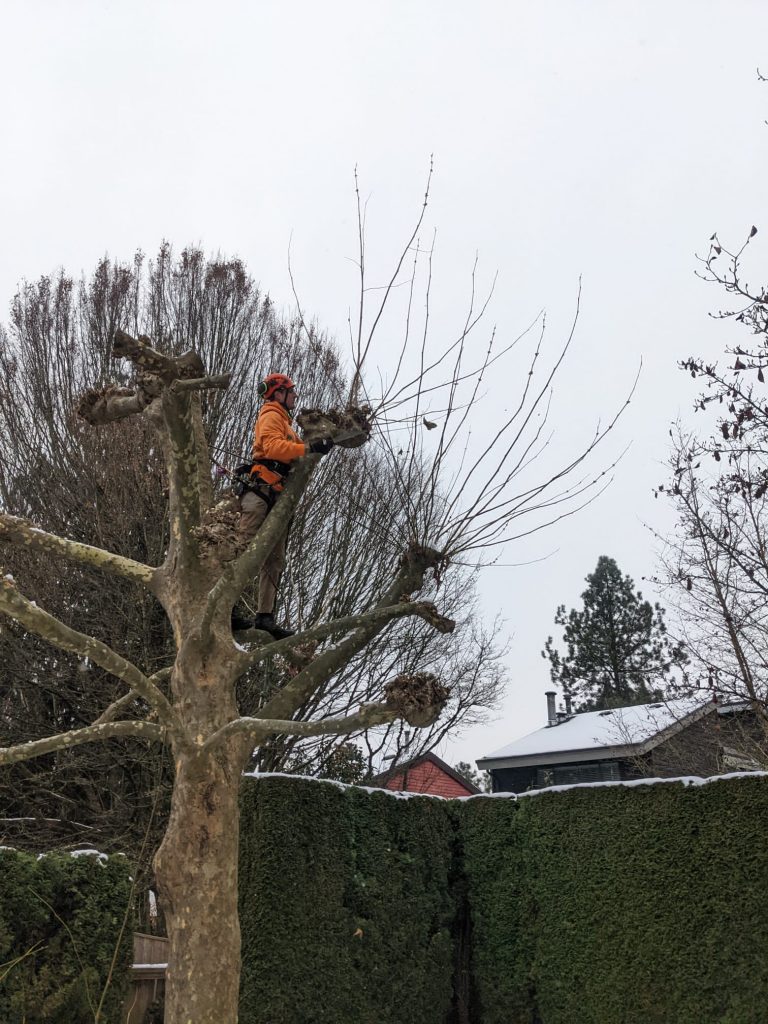
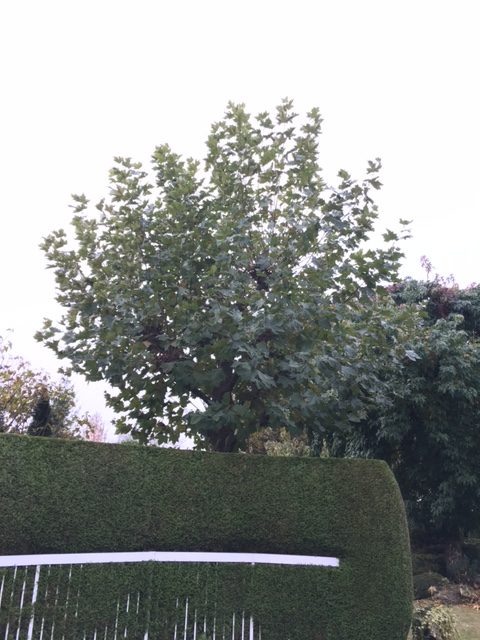
There are three mature London plane (Platanus x acerifolia) trees at a multi-family site (called strata in British Columbia) I know. One of those trees is fairly close to the building so it’s pollarded annually to keep it from getting too big. When people lose their views, they get upset; when gutters get full of leaves, it costs money to clean them up. It’s much easier to pollard the trees every winter.
Pollarding means removing all of the branches and letting the tree resprout. My 2018 blog post on this topic mentioned my distaste for the look of pollarded trees. I naively thought people pollarded trees because they couldn’t prune them properly. How wrong I was.
Then, in 2019, William Bryant Logan released his amazing book “Sprout lands: Tending the endless gift of trees“. It turns out that our civilization was able to thrive thanks to pollarding.
Done correctly, the pollarded wood was used for ships, baskets, wood to heat homes, and food for animals. Pruned trees resprouted new wood and kept on giving, thus the endless gift of trees book subtitle.
I had no idea.
London planes
Now back to our London planes. The three specimens are mature but not as mature as the trees on the boulevard. One, you will recall, is close to the building and the other two are not too far from a pool.
Pollarding involves removing all branches, leaving the funny-looking “knuckles”. It doesn’t look great after it’s done but the tree will never get bigger than this. Assuming you pollard it every year.
The green waste is hauled away but ages ago, it would have been used for firewood or to make baskets.
If your tree is mature, hire an arborist. If it’s smaller, you can easily do it yourself. Just pollard at a height you like. But, always, always, use sharp hand saws and proper safety gear. Tree work can be dangerous.
I must admit that in summer the trees look totally fine. You can’t really see the ugly “knuckles” and we know that the tree will stay roughly this size.
Now I just wish we had some use for the wood we remove.
It’s a lot of fun checking in on old projects to see how they are evolving. At one site we have a long yew hedge to provide privacy for windows.
Originally, the line was planted with cedars (Thuja occidentalis), but they kept on dying and had to be replaced. And as often happens, people get tired of planting the same cedars over and over, only to see them die.
Yew switch
So, we switched to yews (Taxus) because they do better than cedars, especially in hot summers. They also produce red cones (not berries!) which give us something to look at.
I did the switch personally, so I know how much labor was involved.
First, I had to dig up and remove the cedars. Then I had to go pick up the yews and install them. I believe the project cost something like $1,600.
We lost one or two specimens over the last few seasons, which is manageable. When I visited this past summer- remember, I float around as a working manager at my day job- the yew hedge looked great. It was green, healthy, and did the job of providing privacy for a row of windows directly behind it.
When I walked by, I told myself that Red Seal Vas does great work. (Never blow your own horn out loud.)
Fall drought
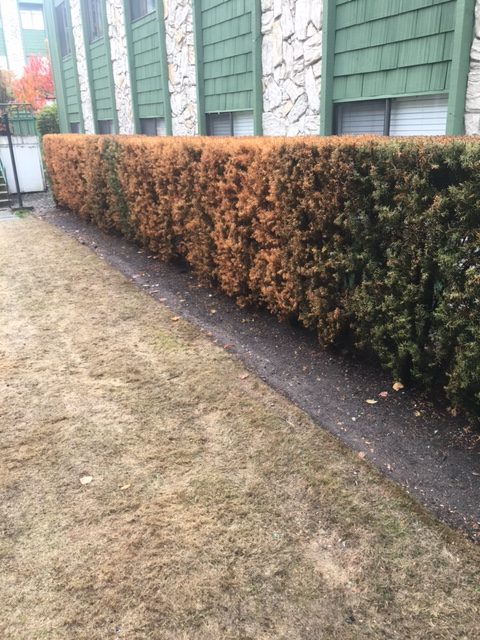
Fall drought: the lawn will recover, the yews won’t.
When I went over to help out this past fall, I nearly cried. Most of the yew hedge was brown and dead! What happened?
This fall we had drought conditions on the West Coast. There was so little rain, many dormant lawns didn’t fully recover before cold temperatures hit and mowing stopped. I had never seen that before.
Now, people are busy working and paying for their overpriced housing. Since they’re used to automatic fall rains, nobody bothered to water the plants. Including my prized yew hedge. Sadly.
And it gets worse. The manager had asked our foreman to clip the top of the hedge even though power shearing in drought conditions is a bad idea; you’re just adding stress. Instead, water the hedge frequently and prune it in fall, when it’s cooler and wetter.
2023
I have no idea what will happen to this yew hedge next year. Now that this blog post is finished, I fully intend to push this hedge out of my mind. The waste of labor and money is stunning. It might be time for people to start getting used to changes brought on by the Global Climate Emergency.
I hate snow but there’s no point crying about it because I can’t control the weather. You just have to make the most of it, like I did today. It’s still November and regular landscape maintenance work got obliterated by snow. So, I made a few phone calls and got ready for work.
I got picked up by snow mercenaries like me at 8 am and we pushed snow off sidewalks and mailbox areas. Since we didn’t have a snowblower, we just shoveled the useless white stuff out of the way. Yes, it can be tiring, especially when people compact the snow. But, hey, it’s good exercise and we’re making money. We’re also making sure kids and the elderly are safe.
One of my crew members dropped her shovel at 9:30 and declared, ” I need a drink”. She meant juice, not alcohol, so we drove to a nearby mall for Starbucks and a washroom break. Always stay hydrated.
Once the snow was gone, we put down ice-melter which will make it easier the next day should more snow fall.
Observe and enjoy
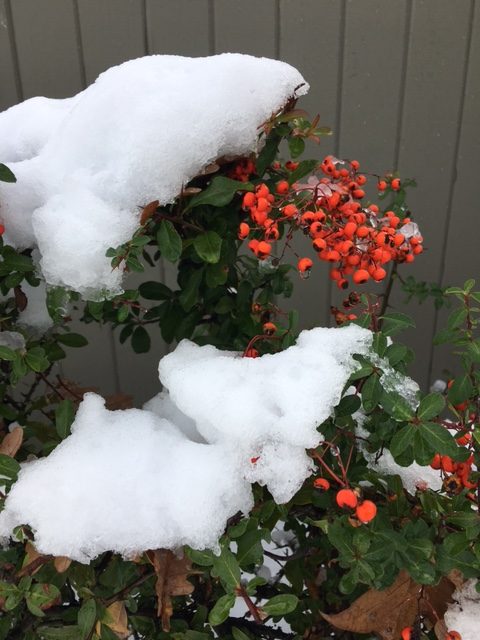
You can also take in the snowy landscape and enjoy it. It was a nice sunny day and I got to see the bright berries on a Pyracantha shrub.
Pyracantha
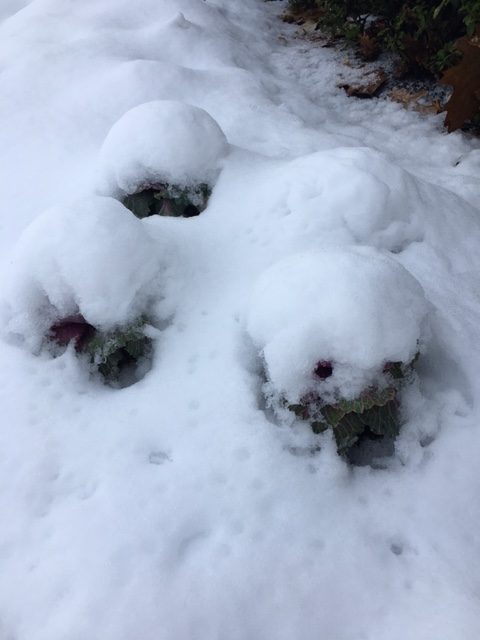
I also got to see winter annuals I planted in fall, covered in snow. Hidden a few inches below the surface are spring bulbs, patiently waiting for spring temperatures to signal a new season. The bulbs need to feel the cold.
Snow covering ornamental kale.
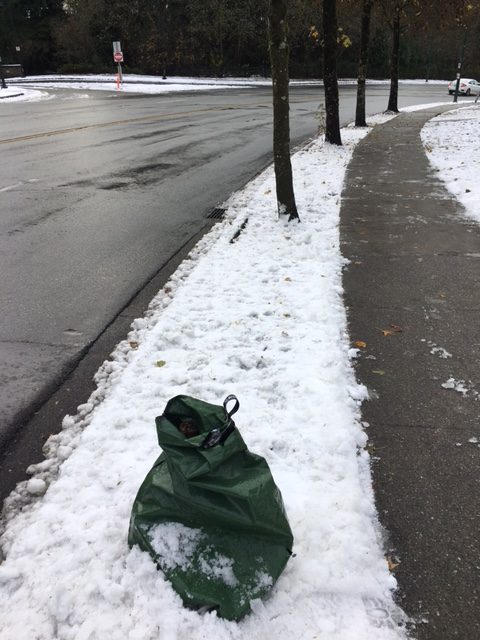
If you look closely, you can also find stuff that doesn’t work well. Like the water bag (not cheap!) covering a tree stump on a municipal boulevard. I mean, it’s winter, so the water bag is useless. Considering how much it retails for, it should be removed and re-deployed next year.
This isn’t working well.
This picture also shows how tough life can be for city trees. If it’s not drought that kills them, it’s bad drivers.
Humans
Just as much fun, if not more, is observing the people on your crew. Some are snow mercenaries like me, ready to shovel snow for cash. Some work for other landscape companies and are now laid-off. One mother of three kept talking about her kids ad nauseam; and the driver showed up on very little sleep because she got stuck in last night’s snow fall.
Once I got home, I texted the office lady with my hours so I could get paid by e-transfer. It was a good day, and we’ll see what tomorrow brings.
I have a great residential client in Port Coquitlam, BC, and his main concern is tidiness. So, when the pin oaks (Quercus palustris) from a neighboring high school drop leaves on his property, he usually calls me in a panic.
Let’s see what I did at this house to put it to bed for the winter.
Lawns
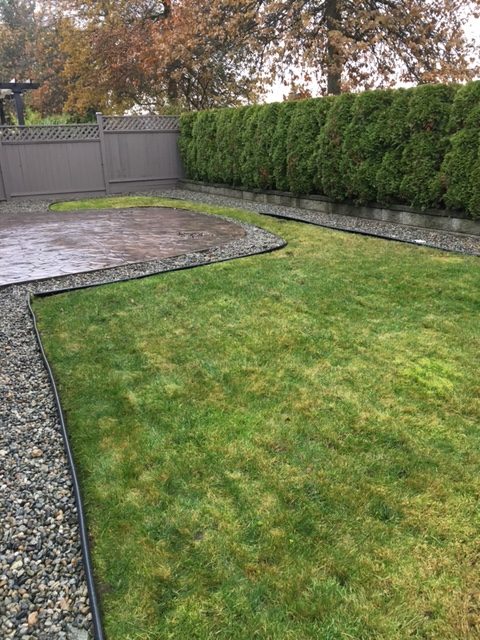
Mowing in late November isn’t ideal but it had to be done. So, I pre-blew the oak leaf drop onto the lawn, raked up the bulk of it and then mowed over the rest. Done! Now we leave the lawns alone until spring.
The front lawn also got a final blade edge which should keep it nice and sharp until spring.
Annuals
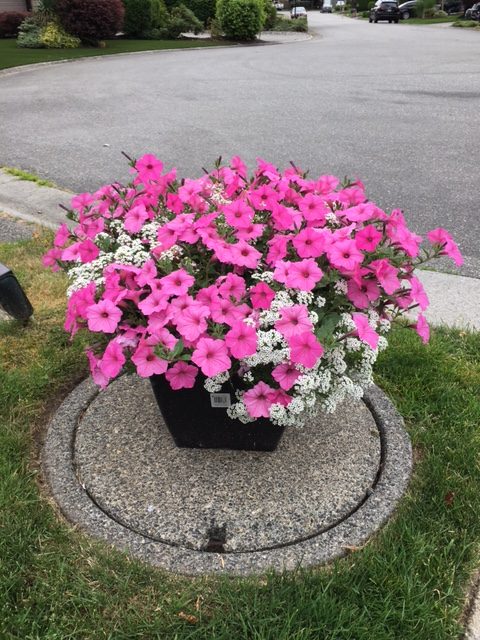
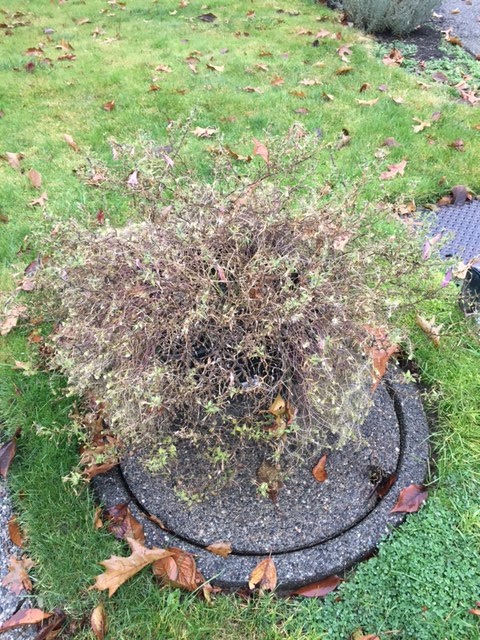
Obviously, annuals are toast by late November. I took out the petunias from the curb pot; and I removed annuals from the front bed. I will most likely plant bulbs in the pot so we can surprise the wife: she loves pretty flowers!
The show is over.
Blueberries
I have never winterized blueberries, so I Googled it and did it anyway. I pruned back most of the canes and moved the pots into a sheltered spot between the fence and shed. Then I put a tarp over the pots.
It might be better to park the pots in the garden shed but that’s not what the owners wanted. And it makes sense. They have two spotless Lexus cars in the garage, and when I forget to blow off their front door seat cushions, they text me about it!
Hydrangea
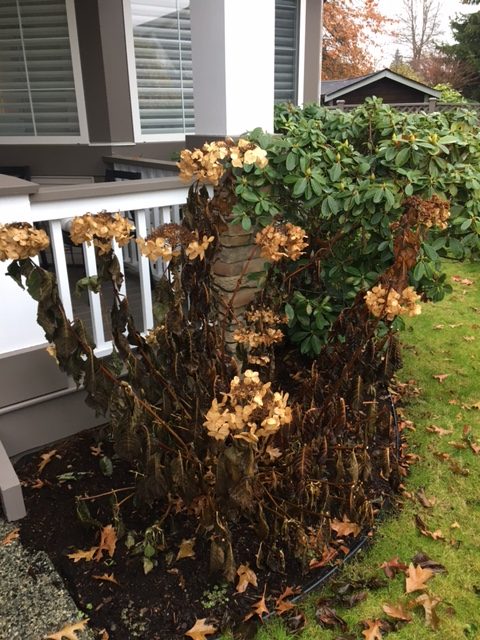
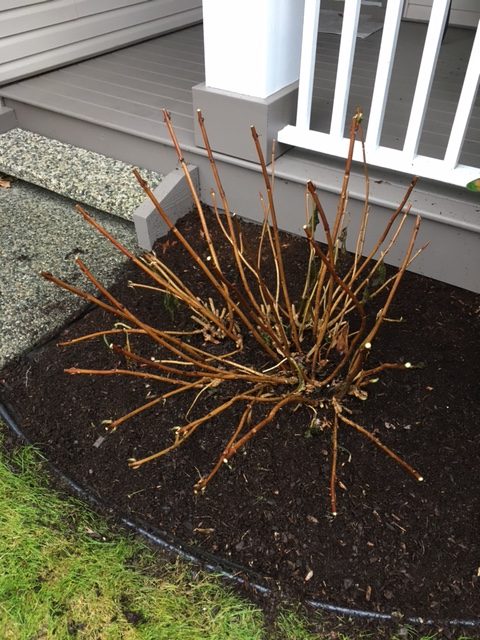
Again, it’s all about the look. The hydrangea was fine; just the leaves were still hanging on and the owners were creeped out every time they used the front entrance. So, I pruned the hydrangea back by a few bud sections and manually removed the spent leaves. If I cut it back too much, into old wood, you won’t get any flowers next year.
Eventually I will remove the canes that are close to the ground but for now it will do.
New planted bed
The new planted bed in the back got a quick cultivate to freshen it up a bit and to uproot any weeds. I deadheaded lavenders and cutback Liatris spicatas. Note that I left the Rudbeckia stems alone. The birds can enjoy the seeds and I can cutback the stems later, closer to spring. When you do this, cut the stem off close to the ground so you don’t leave a stub.
Final blow
As always, everything ends with one final blow, so the property is nice and clean. Since the front lawn is shared with the neighbors, I’m not ashamed to admit that I blasted some of the remaining leaves on the lawn into their groundcover.
There you have it. One last service in late November seals the deal. The garden should hold nicely into spring. I might stop by to blow the stubborn pin oak leaves; and to install the bulbs, secretly.
When I got home, it was dark. So, I made some coffee and sent off my hefty invoice.
It’s always nice to visit old project sites and see how the plants are doing. One such site is at Blue Mountain Park in Coquitlam and when I drove by recently, I pulled over and snapped some pictures. And those pictures took me back eight years.
Back then, I was close to finishing my season as a temporary full-time parks worker with the City of Coquitlam. Our task was to create a brand-new bed for Remembrance Day, which was fast approaching.
City gardener Tracey Mallinson did the initial design, and I did a lot of the labor while she watched me as a hawk. We knew that city managers would bring the mayor over for a visit. Everything had to go smoothly.
Steps
The first step was to measure out the bed dimensions and spray paint the border. Then came the heavy labor part: removing the grass chunks and amending the new bed with fresh soil.
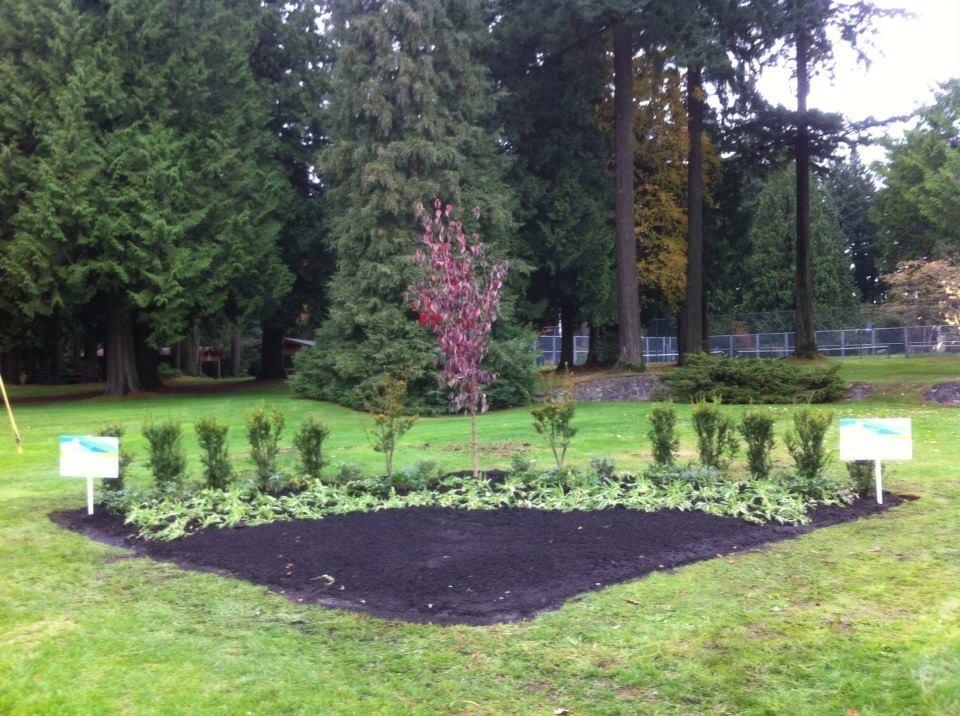
Then we brought in plants and quickly installed them. This is what it looked like.
Fast forward to 2022
Now let’s fast forward to 2022 and see what we have.
2022: 8 years later
Not bad at all! After Tracey Mallinson and I moved on, the raised “poppy” bed was added to make it more visible from the road. It’s planted with red flowers every year to make it look like a poppy.
What I really like is how the yews (Taxus) grew to form a solid hedge. The dogwood tree (Cornus) in the middle is also very special because we planted it bare root. It was my first time planting a tree bare root and I paid attention. It was a lot of fun.
Why bare root?
Bare root planting allows you to see the roots and make some editing cuts, if necessary. We kept the original root ball soil and mixed it with water before backfilling the planting hole. This way the “mud” solidifies and cements the tree in the planting hole.
Years later I would use the lessons I learned here to plant my very first bare root tree solo. You can read about it here. And I’m happy to report that the tree is doing well.
Conclusion
Not every visit to an old planting project site is a happy one. We’ll cover that in up-coming blog posts. But this Blue Mountain project went well. We created a nice new bed for Remembrance Day celebrations, and I took away several important lessons.
Yes, of course you can find me on Google. You can search for landscapers in the Tri-cities area, and you should be able to find me. But people still track me down while I work for other clients. And don’t get me wrong, I love meeting new people and helping them.
Yesterday, I was rushing to complete one more residence before daylight ran out. I had roughly four hours left, three with decent light. So, I blew the leaves into piles and picked them up. Then I gave the lawns one last cut. What light remained I used to prune a Magnolia tree and cut down many perennials; all brown and spent, they were ready for cutback. They’ll be back next year. Don’t worry.
Bittersweet
As I worked yesterday, my focus was on finishing the garden and putting it to bed for the season. The owners are both facing health challenges; challenges so severe that they can’t do their own gardening anymore. So, I’m happy to help them and every dollar I make helps me beat inflation. It’s also nice to see the owners pleased.
It can be distressing to see a weedy garden and long grass outside when your day is dominated by health issues. Incidentally, this also happened when the pandemic first hit, and people had to self-isolate at home. Seeing their landscapers outside on regular basis brought some normalcy to a crazy time.
Then, just as I was finishing, I saw the man approaching. And sure enough, he wanted me to see his garden. These are bittersweet moments for landscape side-hustlers. My focus is on finishing one house, not on taking more work. Now, I know it doesn’t make sense to cry about extra work walking in without any effort on my part. I am grateful for every single client. But in that moment, it’s bittersweet. I want a finish line, not a new race.
I also can’t say no because I know people need help. In this case, the couple moved into their house last summer and now they needed help. Lots of help.
Typical issues
How can Red Seal Vas help you? Well, there is lawn damage from European chafer beetles to fix, and the wife wants pretty flowers by the door where there are only shrubs and groundcovers. In the back, there is a patch of prickly bramble that will only get bigger; and next to it are three alders that will not stop growing until they’re towering over the house.
The garden wall has ivy, Pieris and junipers trailing over the lawn. And the neighbors haven’t touched their trees in a while so now they’re coming over and must be pruned. This actually gets me excited because tree work can be done in winter, just as regular landscape maintenance work ends.
Let’s do it!
Many homeowners need help with their gardens and I’m happy to help, assuming I can fit it into my schedule. You can find me on Google Maps; and approach me when you see me working in your neighborhood. I’m such a landscape slut, it’s unlikely I will say no.
Good landscapers are in great demand at the moment. Some of my previous blog posts showed how easy it was for new immigrants to become landscapers. But what about aboriginal youth?
To answer this question, we’ll consider the case of young Nate (his real name: used with permission). Nate is a great young dude with a partner and a new baby to support. He came to us from a Manitoba reserve where there were few opportunities and the weather sucked. So, Nate packed up and hit the West Coast for British Columbia- the best place on Earth! (If you ignore the current brutal housing situation.)
Right spirit
Nate possesses the right kind of spirit: a mix of initiative, playfulness, willingness to learn and can-do attitude. We found that out when Nate joined us for a company weekend getaway at the Wildlings Resort.
Once he got settled into his cabin, Nate launched his rental boat onto the lake, stocked annually with trout, and emerged hours later with a huge catch. All of his work mates observed the two fish limit, and they were stunned. But not Nate. This was his native land and there were no limits. His wide poacher’s grin proved it.
Luckily for Nate, his work mates were all too overcome by alcohol and legal marijuana to report him to the nearest conservation office. By the time they agreed on the correct “poacher” spelling, Nate had the fish gutted and iced with frightening efficiency. He also followed the old native custom of sharing by giving some fish away to his cabin mates.
Training
Now, when your apprentice has the right attitude, it’s easy to train him. Or her. That’s where Red Seal Vas comes in. Journeymen are supposed share their knowledge with apprentices in the field; and enjoy the process. The company gets a better trained, confident employee; and the apprentice gets valuable skills. With the right skills, young Nate can never be unemployed. The new skills are his to keep; better pay and advancement follow.
Now, let’s see how this works in the field with actual examples. Nate had the pleasure of my company for just a few hours, and this is what we covered.
Styrax pruning
We found some crossing branches inside a Japanese snowbell tree (Styrax japonicus), so I got Nate to remove them. When he pulled out a rusted hand saw he found on site earlier, buried in debris, I had to remind him to always use sharp hand saws. If your hand saw blade is rusty, get a new one and replace it. Making sharp cuts is mandatory.
We also reviewed the tree’s botanical name, Styrax japonicus. The specific epithet refers to Japan. Plant identification skills are very important for landscapers.
Lavender
Mid-November is a good time to deadhead spent lavender flowers. Use good hand snips, carefully grab a handful of flower spikes, and snip them off. The trick is to watch your fingers, so you don’t cut yourself. Don’t rush but don’t waste time snipping single flowers. Grab a handful.
Gunnera
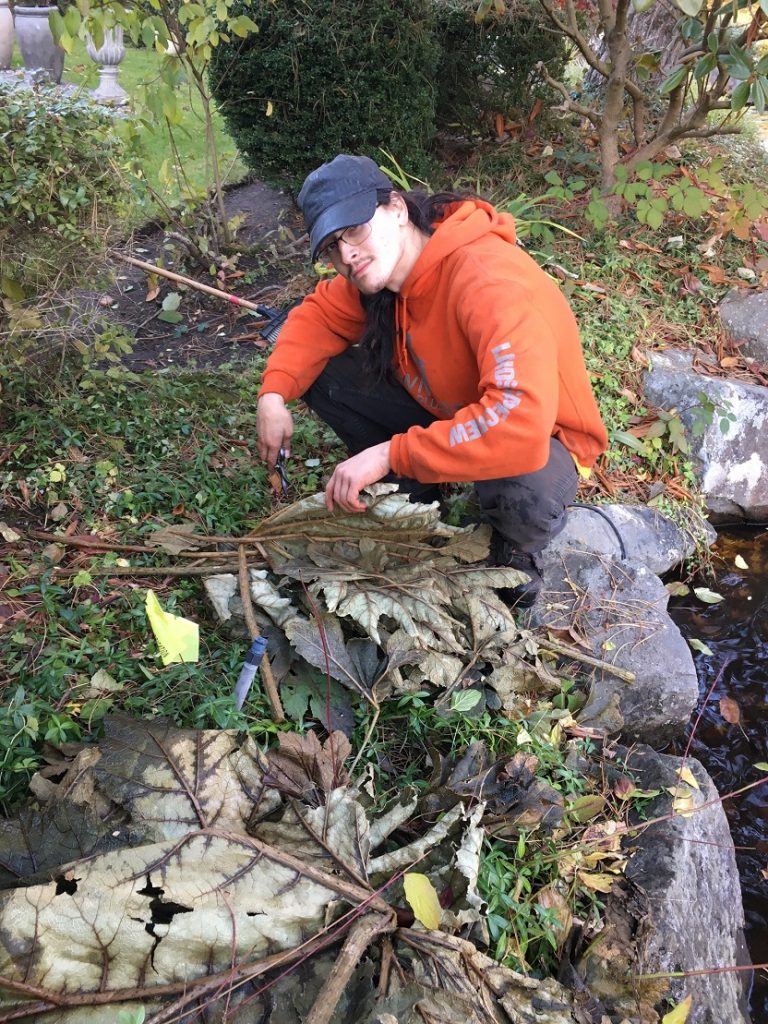
Gunnera is an herbaceous flowering plant with large leaves. We found a cluster of them by a water feature. Since it was mid-November, the large leaves were flat on the ground and fading fast. When you moved the leaves, you could see the plant bases where growth occurs.
So, I showed Nate how the big leaves get flush cut at the base but not discarded with other green waste. Instead, we stack the large leaves on top of the plant bases, to keep them cozy in winter.
Nate cutting back Gunneras
Conclusion
By now the answer to my question above should be clear. Aboriginal youth can definitely be developed into landscape professionals with the right kind of training and support from employers; and journeymen willing to teach people. I’m confident that young Nate will do well in 2023.
With low temperatures forecast for next week, today I received phone calls from several panicked homeowners looking to get their leaves picked up. I will squeeze in a few but I rarely work on-demand. I’m too busy with regular clients.
And this afternoon, as I headed to one of my regular residential clients, they informed me that they were keeping all of their leaves in their beds. Working on a garden design across the street, a horticulturist recommended that they mulch their beds with leaves. So, this is the change for 2022: leaves stay in beds so they can insulate the plants against harsh low temperatures. The forecast for this coming week says as low as -14C.
Leaves as mulch
Leaves can definitely be used as mulch in planted beds. A layer of leaves can insulate your plants from low winter temperatures. However, some clients can’t stand the look of their beds, stuffed full of leaves, especially in high-profile beds. Then the wind picks up and it’s a mess. So, you decide.
Insulation is one thing, but quick leaf decomposition that will benefit the plants might be a bit exaggerated. If you expect your plants to benefit from decomposed leaves, then the best first step is to shred them.
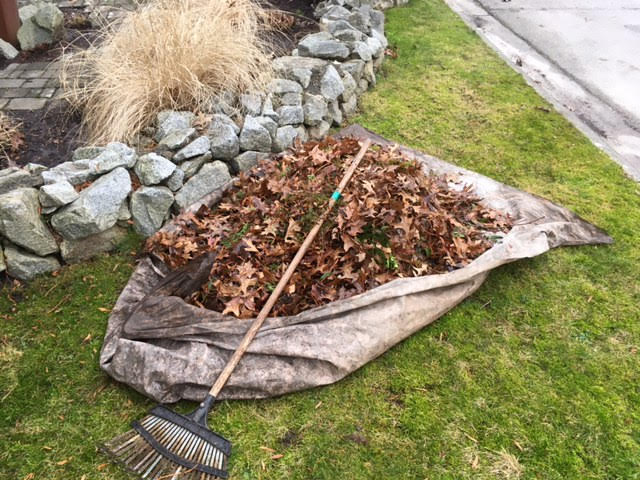
Simply pile them on your lawn and run your mower over them. Whole leaves take longer to decompose. And, speaking of lawns, it’s always a good idea to clear leaves off your lawn so you don’t get weird light-colored zones in your lawn as the grass is smothered.
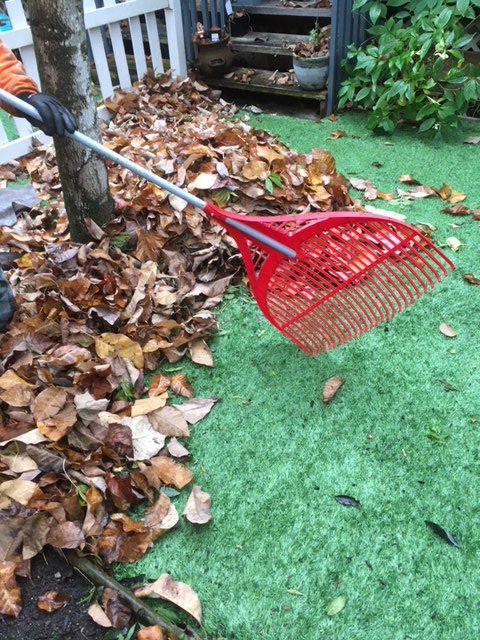
Never shred your leaves on top of plastic turf!
Same old, same old?
I love the idea of clients trying different things. Why not mulch your beds with leaves instead of removing them every year. Are you tired of your perennial bed? Rip out some of your plants and get new ones.
Your garden shouldn’t be static; gardens are never finished: they evolve.
I’m perfectly happy to adjust to different client requests. There is always something to do, like perennials to cut back or broken tree branches to remove.
Enjoy the off-season and make some plans for next year.
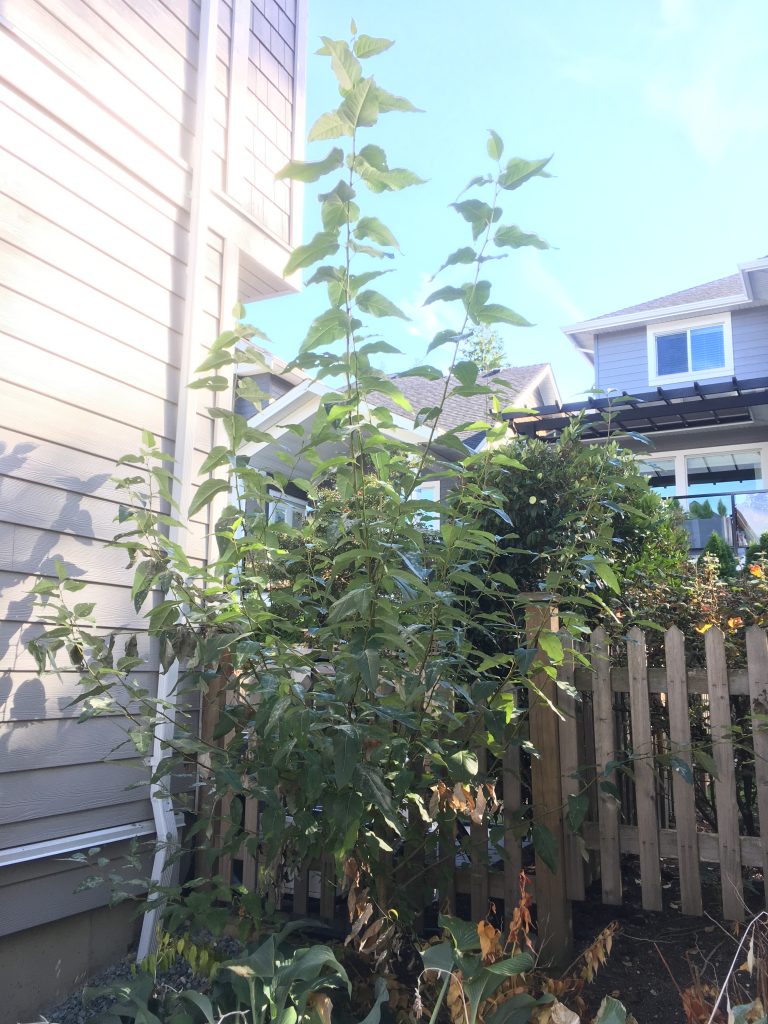
There was a young cottonwood growing in between two strata (multi-family complex) units. And our young landscape foreman panicked, unsure about the plant species. It looked like a lilac (Syringa vulgaris) and he wasn’t about to prune or remove a lilac shrub.
What if the fragrant flowers go missing and the owners blame him for it. So, he let the shrub grow. Until the boss showed up and ordered him to remove it.
What struck me was the dude’s panicked face. This is the same dude who can tell good marijuana from junk full of straw; and we know he has a mobile phone with Google access. Why then is he so shy?
Let’s settle it
As soon as I heard this story, I knew I had a new blog post handed to me. So, I took some pictures and then life and work got busy. But, the idea was written down and saved for later. Which would be today, March 2022, and the blog post will get published in June 2022.
So, let’s settle this, without Google. Cottonwood (Populus trichocarpa) is a fast growing tree. At maturity it can be over 30m in height. When I photographed it, it was still a manageable baby tree; and fairly easy to remove. When cottonwoods mature, they tend to self-prune by dropping branches. Left to mature in this location, that would mean exposing families to branch bombardment.
This cottonwood is very happy here but it can’t stay.
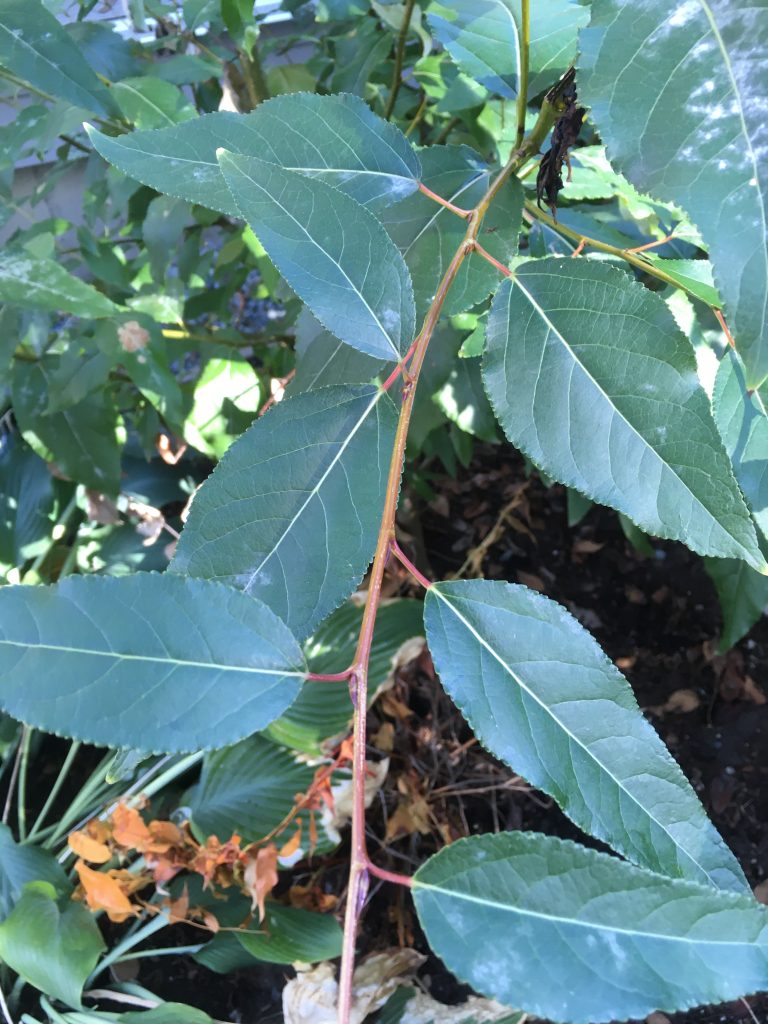
Since we don’t have pictures of flowers, the key distinction between the two species is leaf arrangement. Cottonwood trees have alternate leaf arrangement.
Alternate leaf arrangement.
Now, when I think of lilacs, I think of shrubs with showy fragrant flowers. As a boy in Prague, I used to climb a mature lilac at my grandpa’s villa. I know the fragrance really well and still find it intoxicating.
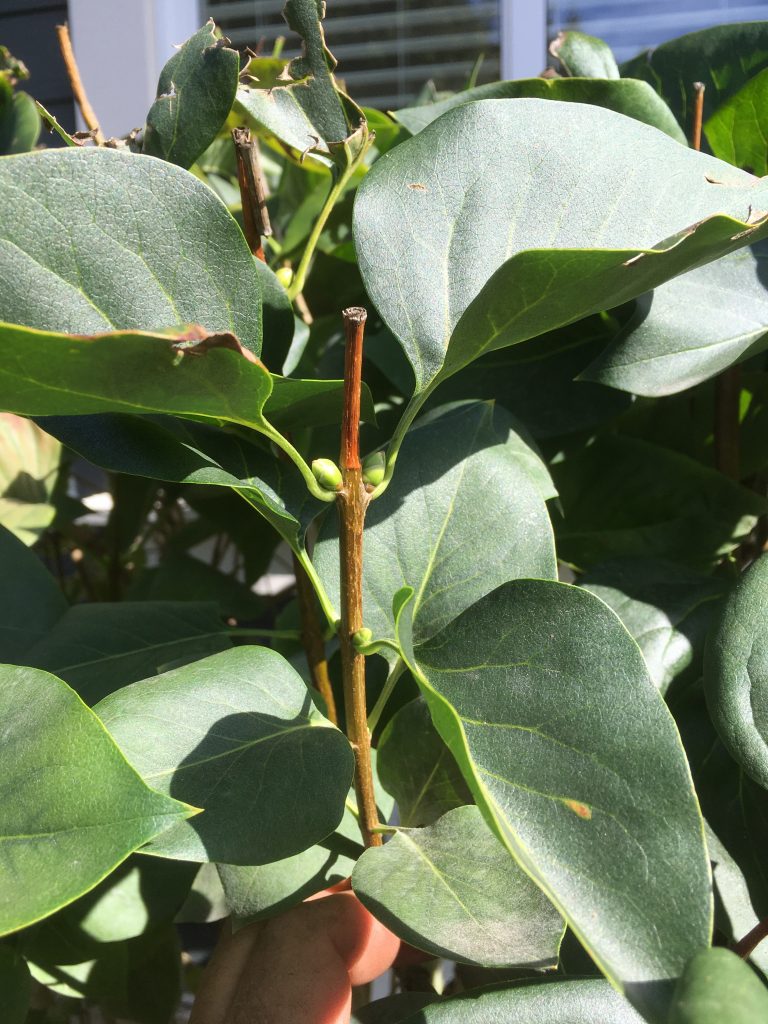
Again, at the time, we didn’t have flowers so let’s look at lilac leaf arrangement: it’s opposite and whorled.
Opposite leaf arrangement on Syringa vulgaris. Note the fat buds as well.
Unlike cottonwoods, lilacs don’t get as tall. They might reach something like 5-7m at maturity.
Have no fear
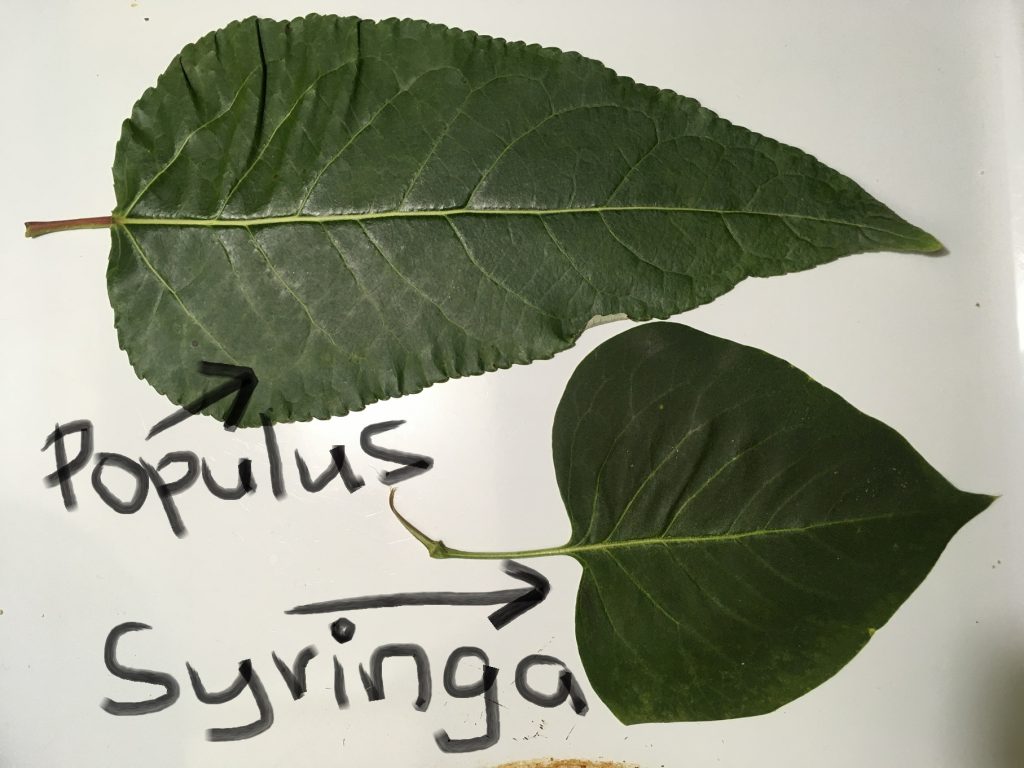
Let’s be honest, most people know what lilacs look like but, if you look quickly, there are some similarities between the leaves. Still, lilacs versus cottonwoods shouldn’t even come up for a landscape foreman with experience.
Have no fear! If you’re not sure about a plant species, look it up and key it out. You might learn something.
Landscape side-hustles come with many benefits. It’s not just cash, even though today, in spring 2022, cash sounds great. Interest rates are going up, inflation is at 6% and gas prices are close to $2/L. Add to that Putin’s war in Ukraine, and making some extra cash on the side sounds great. Don’t even get me started on my daughter’s braces.
Ideas
Working at my regular landscape manager job and side-hustles provides me with plenty of blog post ideas. That’s gold and it keeps things interesting. Some homeowners are hilarious, like the lady with a potted hydrangea, wondering if she should prune it. I could count just a few short stems so her specimen should be left alone for at least one season. Then she might get some flowers in 2023.
Obviously, professional blogging is a form of side-hustle in itself. Always look for new opportunities. I became a pro blogger when the owner of this website needed some posts for his website.
Practice!
Extra side-work allows you to practice your craft; and it’s often more enjoyable because it’s not done on an hourly basis. I know I can install three yards of mulch fairly quickly and leave the clients with a good looking front yard that will stay weed-free for months.
Fresh mulch and happy clients!
Every pruning job, lawn care fix and question answered build up your confidence, knowledge and experience. The most interesting gigs are turned into blog posts. Of course they are.
Networking
Another benefit of side-hustling is enlarging your network. Some people may not need your services right away but they can recommend you to others. Or what seems like a lunch money kind of gig can grow like wildfire.
Once we were approached by a homeowner from across the street. Because his lawn patch looked small, my buddy immediately rejected the man and sent me over. Two years later, I’ve done more work for him and his friends; and I have access to even more work this season. All because I said yes to an easy job.
Look past money, enlarge your network and reap the benefits. I now have a client who likes my work and wants to continue to work with me on his various projects. That feels good.
Solving problems
Side-hustle work can also allow you to genuinely help people. Like the nearly deaf 86-year-old woman living alone who can no longer mow her own lawn but enjoys looking at one.
Or the man with retina problems who isn’t allowed to lift anything. He can’t do his own landscaping work and I’m happy to do it for him. When his daughter got married last summer, I pimped out their house so it looked great.
Fresh mulch, in time for wedding guests.
Now they’re moving and I will be their gardener at the new place! That’s a good client. If you do good work, don’t be afraid to say it.
Then you have the obvious case of the well-to-do people who are too busy to do their own weeding. They leave it up to you and e-transfer you money when you ask. Diving into their pool is a better use of their time.
The funniest was a lady who called me about a final lawn cut in fall. She needed help because her mower wasn’t working. So, I came over, and discovered that her mower was totally fine. The gas valve was shut off: mowers run on gas so the line must be open.
I cut her lawn and gave it much-needed edging. Who knows, she might need help again in 2022. I haven’t asked yet.
The best “client” I have is a buddy who doesn’t care about his landscaping and refuses to put money into it. When his neighbours start whispering, he calls me to knock down the wilderness.
A wild backyard I get to knock down once in a while.
Nothing new
Side-hustles are now an accepted part of life in Canada and the US. Many people make extra money on the side. Landscaping is made for side-hustlers. You don’t even have to advertise because people will approach you when they see you work.
And while some people will try to save money and do their own work, many happily accept your offers of help. Good clients also let you teach them, that’s why they’re gold.
Do it!
If you get a chance to try a side-hustle, do it. It can be a source of extra fun, income, practice and it can enlarge your network. Give it a try.